2026 ADHD Mind Reset Journal Editable: Your Practical Anchor for Focus, Calm, and Intentional Living
If you’re an adult with ADHD, you know how quickly the new year can shift from hopeful to overwhelming—especially when traditional planners assume linear thinking, sustained attention, and predictable energy levels. The 2026 ADHD Mind Reset Journal Editable isn’t another rigid schedule builder. It’s a responsive, compassionate, and highly adaptable tool designed *with* ADHD neurology—not against it. More than a planner or journal, it’s a daily reset button: a space where focus isn’t forced, clarity emerges through structure (not suppression), and self-care becomes non-negotiable—not an afterthought.
Why “Just Try Harder” Doesn’t Work—and What Does
Many adults with ADHD have tried bullet journals, digital task apps, or generic wellness planners—only to abandon them within weeks. Why? Because they often lack three essential elements: neuro-inclusive design, low-barrier entry, and built-in emotional scaffolding. Without these, even well-intentioned tools amplify shame, increase cognitive load, or demand more executive function than is available on a low-energy day.
Common challenges include:
- Starting tasks but struggling to sustain attention or follow through
- Feeling emotionally flooded by small decisions or unexpected changes
- Overlooking medication timing, hydration, or rest until burnout hits
- Replaying criticism or self-doubt without tools to interrupt the loop
- Setting ambitious goals—but lacking bite-sized, flexible action steps that honor fluctuating capacity
The 2026 ADHD Mind Reset Journal Editable meets those realities head-on—not by fixing your brain, but by working *with* how it naturally processes information, emotion, and time.
How It Supports Real-Life ADHD Experiences—Not Just Ideals
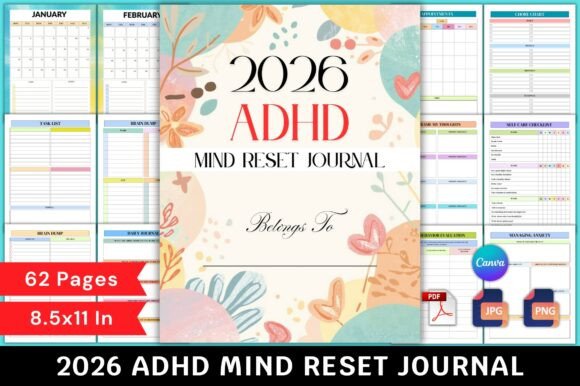
This isn’t about perfection. It’s about consistency built on compassion and customization. Because the 2026 ADHD Mind Reset Journal Editable is fully editable (PDF or compatible with GoodNotes, Notability, or tablet stylus), you decide what stays, what shifts, and how much—or how little—you engage each day.
For the overwhelmed starter: Begin with just one Brain Dump page each morning. No rules. No formatting. Just release mental clutter onto paper—then optionally sort it later using the included Task Triage guide. That simple act reduces background anxiety and frees up working memory for what matters *now*.
For the chronically distracted planner: Use the Priority Matrix (Urgent/Important + Energy Required) instead of standard to-do lists. This helps you weigh not just *what* needs doing—but whether it aligns with your current bandwidth. A “low-energy Tuesday” doesn’t mean skipping everything—it means choosing one high-impact, low-effort action (e.g., sending one email vs. drafting three reports).
For the emotionally reactive thinker: The Daily Journaling Reflection section includes gentle, non-judgmental prompts like “What did my body need today?” or “When did I feel safe?” Paired with mood logs and self-talk rewiring exercises, it builds awareness *before* overwhelm escalates—so you respond, rather than react.
Practical Outcomes You Can Experience—Not Just Hope For
Users consistently report tangible shifts within 3–4 weeks of consistent, flexible use:
- Reduced decision fatigue: With pre-designed habit trackers (medication, movement, hydration, sleep), you’re not asking “Did I take my pill?”—you’re checking a box. That saves dozens of micro-decisions weekly.
- Stronger boundary awareness: The “Happy List” and gratitude pages retrain attention toward what energizes you—not just what drains you—making it easier to say no to misaligned commitments.
- Improved emotional regulation: Regular use of the anxiety trigger tracker + reframing worksheet helps identify patterns (e.g., “I panic before meetings because I associate them with past shame”)—and gently replace old narratives with grounded, present-moment truths.
- Sustainable goal progress: Instead of vague intentions (“get organized”), Goal Action Plans break targets into sensory-friendly steps (“Open drawer → photograph contents → label one shelf → repeat tomorrow if energy allows”). Progress compounds—even in tiny increments.
Tailoring the 2026 ADHD Mind Reset Journal Editable to *Your* Rhythm
No two ADHD experiences are identical—and neither should your journaling practice be. Here’s how different users adapt it:
- The hyperfocus-driven creator: Uses monthly calendars as idea incubators—sketching concepts, mapping creative sprints, and scheduling “deep work windows” *around* natural energy peaks—not against them.
- The people-pleaser recovering from burnout: Prioritizes the Self-Care Checklist and “Permission Slip” affirmations first. They start small—checking off “drank water” and “stepped outside for 90 seconds”—rebuilding trust in their own needs.
- The newly diagnosed adult: Leans into the mindfulness and limiting beliefs worksheets to process years of internalized stigma. The editable format means they can add personal definitions (“ADHD strength = noticing patterns others miss”) right alongside clinical notes.
- The parent juggling work, kids, and executive function: Uses the doctor visit log + medication tracker across family members, color-coding entries. The “Daily To-Do List” includes only 2–3 non-negotiables—plus one “joy anchor” (e.g., “dance while making dinner”).
Getting Started—Without Pressure or Prep
You don’t need to begin on January 1st. You don’t need fancy pens or perfect handwriting. And you absolutely don’t need to fill every page.
Try this low-stakes launch sequence:
- Download the 2026 ADHD Mind Reset Journal Editable and open it on your device or print the first week.
- Flip to the Brain Dump page. Set a timer for 90 seconds. Write *anything* swirling in your mind—no editing, no grammar, no judgment.
- Circle ONE thing from that list that feels lightest to address—or most urgent to release.
- Turn to the Daily To-Do List. Write only that one item. Add one self-care micro-action beside it (e.g., “Text friend” + “sip warm tea while typing”).
- Close the journal. Breathe. That’s enough.
Consistency grows from kindness—not compliance. The 2026 ADHD Mind Reset Journal Editable gives you permission to show up exactly as you are—and supports the gradual, resilient rebuilding of focus, calm, and self-trust—one intentional, editable moment at a time.