Turn Everyday Wins Into Cosmic Adventures With the Outer Space Reward Chart
Every child thrives on recognition — not just for big milestones like riding a bike or reading their first chapter book, but for the quiet, consistent efforts that build confidence and character: putting toys away without being asked, trying a new food, staying calm during transitions, or completing homework before screen time. Yet traditional praise alone often fades quickly. What sticks? A sense of progress — visible, joyful, and deeply personal. That’s where the Outer Space Reward Chart transforms routine into revelation.
Why Space? Because Growth Feels Like Exploration
Space isn’t just a theme — it’s a metaphor kids instantly understand. Launching a rocket takes preparation. Landing on Mars requires patience, problem-solving, and small course corrections. So does learning to tie shoes or manage big feelings. The Outer Space Reward Chart taps into that innate fascination with discovery, turning behavioral goals and daily habits into missions. Astronauts don’t succeed in one giant leap — they train, track, adjust, and celebrate each milestone. Neither do kids.
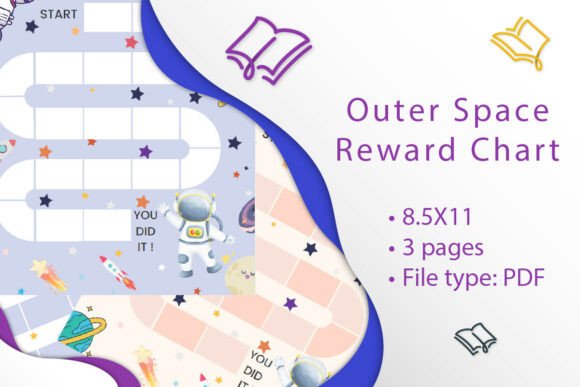
Unlike generic star charts or abstract checklists, this set invites children into a vivid, cohesive world: rockets lift off from the “START” section, planets orbit as visual markers of consistency, and stars shimmer with every completed task. The “YOU DID IT!” finish line isn’t just a box to tick — it’s a celebration zone, complete with confetti-style constellations and triumphant astronaut poses. That emotional resonance makes the chart more than a tool — it becomes a story the child co-authors.
Three Colors, One Purpose: Flexibility Built In
No two kids respond the same way to color. Some feel energized by bold primaries; others find deep blues and purples calming. That’s why the Outer Space Reward Chart includes three distinct color variations — all high-contrast, print-optimized, and designed for clarity at a glance. Whether you’re supporting a sensory-sensitive learner in therapy, guiding a wiggly kindergartener through morning routines, or helping a third grader stay accountable for homework deadlines, there’s a version that meets their visual needs — and yours.
Each chart is sized to US Letter (8.5 x 11 inches), making it easy to hang on a fridge, clip to a classroom bulletin board, or slip into a homeschool binder. No resizing, no blurry edges — just crisp, vibrant graphics ready the moment you hit “print.” And because it’s a digital download, you can reprint a favorite chart after a spill, loss, or enthusiastic “mission success” celebration (yes, some kids rip theirs down to frame it!).
Real-Life Uses That Actually Stick
The magic of the Outer Space Reward Chart lies in how seamlessly it adapts to real-life challenges — not theoretical ideals.
- Potty training? Turn bathroom visits into “Mission Control Check-Ins.” Each successful attempt fuels the rocket one step closer to orbit. Visual momentum builds confidence faster than verbal reminders ever could.
- Morning or evening routines? Break down complex sequences — brush teeth, pack backpack, choose clothes — into individual planet stops. Kids see exactly where they are, what comes next, and how close they are to liftoff (or bedtime shuttle docking).
- Homework encouragement? Assign one star per completed assignment — or better yet, one per focused 15-minute work block. It shifts focus from “getting it done” to “building stamina,” which is where lifelong learning habits begin.
- Classroom behavior systems? Teachers use these charts to support individualized goals without singling students out. A quiet student working on raising their hand? A neurodivergent learner practicing self-regulation? Each gets their own mission log — private, dignified, and empowering.
And because the chart doesn’t rely on external rewards like candy or screen time, it nurtures intrinsic motivation. The pride in watching their rocket climb, the satisfaction of filling a row of planets, the grin when they point to “YOU DID IT!” — that’s the fuel that lasts.
More Than Just Stickers: How This Chart Supports Development
Behind the playful design lies developmental science. Visual tracking strengthens executive function — the brain’s command center for planning, focus, and self-control. Breaking large goals into smaller, sequential steps builds task initiation skills. Celebrating effort (not just outcomes) fosters growth mindset. Even the physical act of placing a sticker or coloring a star reinforces fine motor coordination and hand-eye integration.
Therapists report especially strong engagement with children who struggle with transitions or anxiety. The predictability of the chart — “After three stars, we launch to Jupiter!” — creates safety. The space theme adds emotional distance from shame or frustration (“It’s not *me* failing — it’s the rocket needing more fuel!”). That subtle reframing opens doors to cooperation, reflection, and resilience.
What’s Inside the Download — And Why It Matters
You’ll receive three high-quality PDF files — no subscriptions, no watermarks, no hidden fees. Just clean, professional-grade charts optimized for home printers (inkjet or laser) and school copiers alike. Each file is print-ready: properly scaled, CMYK-friendly, and designed with generous margins so nothing gets cut off. There’s no software to install, no app to update — just instant access and immediate usability.
This simplicity is intentional. Parents don’t need another tech platform to manage. Teachers shouldn’t have to troubleshoot compatibility issues mid-lesson. Caregivers supporting multiple children or routines need reliability — not complexity. The Outer Space Reward Chart respects your time, your bandwidth, and your intention to show up consistently for the kids in your life.
Choosing the Right Tool for Your Child’s Journey
When evaluating reward systems, families and educators often ask: Is this sustainable? Will it shame if progress slows? Does it grow with the child? The Outer Space Reward Chart answers yes — thoughtfully.
It’s reusable across ages and goals. A toddler might earn stars for using gentle hands; a preteen might track kindness acts or study hours. You decide the criteria. You set the pace. You celebrate the effort — even on days when the rocket only made it to the moon’s surface. That flexibility prevents burnout for adults and discouragement for kids.
It also avoids common pitfalls: no comparison to peers, no public shaming if a goal isn’t met, and no reliance on material prizes that lose meaning fast. Instead, it centers connection — “Let’s check your mission log together,” “Which planet should we color next?” — turning discipline into dialogue.
Your Next Step Isn’t a Leap — It’s a Launch
Motivation isn’t something you pour into a child. It’s something you help them uncover — like buried treasure beneath layers of doubt, distraction, or discouragement. The Outer Space Reward Chart doesn’t create motivation out of thin air. It reveals it — in the steady glow of a completed row, the proud tap of a finger on “YOU DID IT!”, the quiet hum of focus as a child chooses their next mission.
This isn’t about perfection. It’s about presence. It’s about saying, without words: Your effort matters. Your progress is seen. Your journey — whether it’s mastering zippers or navigating middle-school stress — is worthy of celebration.
So go ahead — download the set. Print one chart. Grab some stickers or crayons. Sit beside your child, point to “START,” and say, “Where shall we launch today?” Because every great adventure begins not with certainty, but with curiosity — and the courage to begin.