500 Mental Health Prompts Canva Template: A Flexible, Self-Directed Journaling Resource
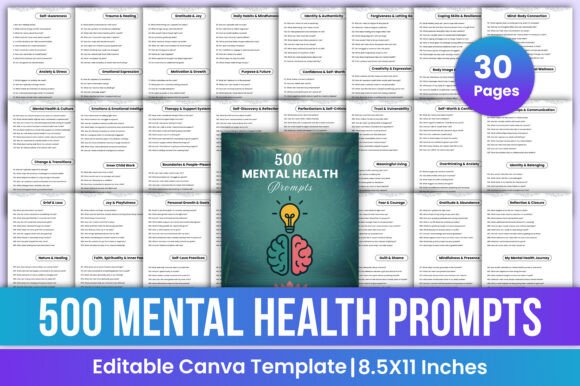
The 500 Mental Health Prompts Canva Template is a digital guided journal designed for adults seeking structured yet adaptable self-reflection. Unlike static printable journals or rigid app-based programs, it delivers 500 thoughtfully curated prompts across 27 thematic categories—including self-awareness, anxiety and stress, emotional expression, boundaries, trauma healing, gratitude, resilience, and digital wellness—and packages them into an editable Canva file. This means users aren’t just consuming content; they’re actively shaping how it appears, reads, and fits into their personal workflow.
What Sets the 500 Mental Health Prompts Canva Template Apart
Its defining feature is customizability without technical barriers. Each prompt page—whether exploring inner child work or evaluating workplace mental health culture—is built as a Canva template. You can adjust fonts, colors, spacing, layout orientation (portrait or landscape), and even rearrange sections to match your priorities. For someone managing chronic anxiety, that might mean pulling all “Coping Skills & Resilience” prompts into one cohesive section. For another person recovering from people-pleasing patterns, it could mean merging “Boundaries,” “Self-Worth,” and “Letting Go” into a single visual flow.
This flexibility contrasts with fixed-format resources. Traditional guided journals often follow a linear, date-stamped structure—helpful for consistency but limiting if your needs shift weekly. Many mental health apps offer prompt libraries, but they’re locked behind interfaces, subscription tiers, or algorithm-driven suggestions that don’t reflect your lived context. The 500 Mental Health Prompts Canva Template avoids those constraints: no login, no tracking, no forced progression. It lives on your device or cloud storage, and you decide when, how, and how deeply to engage.
How It Fits Into Broader Journaling and Mental Wellness Practices
Journaling for mental health isn’t one-size-fits-all. Some people benefit most from narrative writing—long-form entries that process emotion over time. Others respond better to micro-reflections: brief, targeted questions that interrupt rumination or clarify values. The 500 Mental Health Prompts Canva Template leans into the latter—but supports the former, too. Because each prompt is editable, you can expand a short question like “What does safety feel like in my body right now?” into a multi-part reflection, or convert a gratitude prompt into a bullet-list habit tracker.
It also bridges gaps between clinical support and everyday practice. Therapists often assign homework involving self-inquiry, but printed worksheets can feel impersonal or outdated. With this template, clients—or individuals working independently—can tailor prompts to align with therapeutic goals: CBT-style cognitive restructuring, ACT-based values clarification, or somatic awareness cues tied to the “Mind-Body Connection” section. That doesn’t replace therapy, but it strengthens continuity between sessions and daily life.
Practical Strengths—and Realistic Tradeoffs
Strengths include:
- Ownership and privacy: No data collection, no third-party access—ideal for sensitive topics like trauma healing or identity exploration.
- Low barrier to entry: Requires only a free Canva account and basic familiarity with drag-and-drop editing.
- Scalable depth: Users can start with one prompt per day or dive into thematic deep dives (e.g., spending a week solely on “Perfectionism & Self-Criticism”).
- Visual adaptability: Color schemes and typography can be adjusted to support neurodivergent needs—soothing palettes for anxiety, high-contrast layouts for focus, or minimalist designs to reduce cognitive load.
Tradeoffs to consider:
- No built-in accountability or reminders: Unlike apps with push notifications or streak tracking, consistency relies entirely on user initiative.
- No audio, video, or interactive elements: It’s text- and design-focused—not suited for users who learn best through voice notes, guided meditations, or dynamic exercises.
- Requires light tech engagement: While Canva is intuitive, those unfamiliar with digital design tools may need 20–30 minutes to orient themselves before journaling begins.
- No clinical oversight: Prompts are informed by evidence-based frameworks (e.g., mindfulness, compassion-focused therapy), but they aren’t diagnostic tools or substitutes for professional care.
When the 500 Mental Health Prompts Canva Template Is Likely the Right Fit
This resource works well for adults who value autonomy in their mental wellness routine and already have some baseline self-reflection skills. It’s especially helpful during periods of transition—career shifts, relationship changes, recovery milestones—when standardized journaling feels misaligned with where you are. For example, someone navigating “Change & Transitions” might reorder the template to foreground future-oriented prompts (“What version of myself am I practicing becoming?”) while temporarily setting aside “Trauma Healing” until readiness increases.
It also suits people who’ve tried other formats without sustained engagement. If pre-filled journals felt too prescriptive, or apps felt distracting or monetized, the 500 Mental Health Prompts Canva Template offers middle ground: structure without rigidity, guidance without gatekeeping.
When Another Option May Serve Better
For individuals newly beginning their mental health journey—or those experiencing acute distress, active suicidal ideation, or untreated trauma—the template alone isn’t sufficient. In those cases, working with a licensed clinician, using crisis resources, or choosing a clinically validated program with real-time support is essential. Similarly, learners who thrive with auditory input, step-by-step instruction, or community interaction may find the template isolating without complementary tools.
People needing highly specialized content—such as DBT skill-building worksheets, EMDR preparation guides, or culturally specific healing frameworks—may need to supplement the template with targeted materials. While the 500 Mental Health Prompts Canva Template covers broad, widely applicable themes, it isn’t designed to replicate discipline-specific interventions.
Using It Alongside Other Tools—Not Instead of Them
In practice, many users combine the template with other resources. A therapist might assign a customized Canva page as homework, then review insights in session. Someone building daily mindfulness habits may paste selected “Daily Habits & Mindfulness” prompts into a physical bullet journal. Others use Canva’s export features to generate PDFs for printing, or convert pages into slides for group facilitation in peer support settings.
This interoperability is part of what makes the 500 Mental Health Prompts Canva Template durable over time. As your needs evolve—from early-stage self-discovery to long-term maintenance—you’re not locked into one format. You can archive old versions, duplicate pages for experimentation, or merge prompts with external frameworks like the Wheel of Life or Values Card Sort.
Final Considerations for Thoughtful Evaluation
Choosing a mental wellness tool isn’t about finding the “best” option—it’s about identifying what fits your current capacity, learning style, and goals. The 500 Mental Health Prompts Canva Template excels when you want agency, simplicity, and room to grow into your own process. It won’t automate insight or guarantee progress—but it does offer 500 intentional invitations to pause, notice, and choose differently.
If you value clarity over convenience, depth over speed, and personalization over polish, it’s worth exploring. And because it’s editable on Canva, there’s little risk in trying: you shape it before you commit to it.