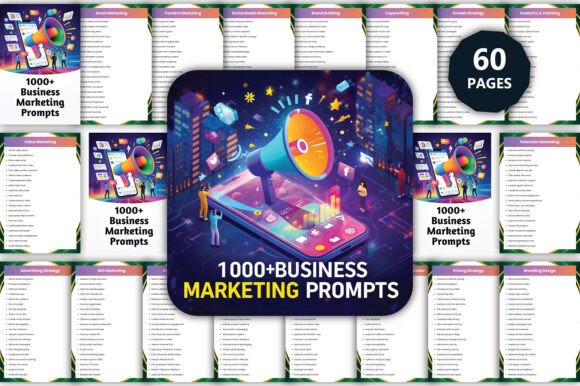
1000 Business Marketing Prompts
If you’ve ever stared at a blank document before drafting a social media post, struggled to define your brand voice for a new audience, or spent hours brainstorming campaign angles only to circle back to the same ideas—this is where 1000 Business Marketing Prompts changes the workflow. It’s not another template library or generic checklist. It’s a deeply organized, editable collection of actionable starting points—spanning over 50 marketing disciplines—from Brand Building and SEO Marketing to Crisis Marketing and Neuromarketing.
Why Prompts—Not Just Templates—Make a Real Difference
Prompts work differently than static templates. A template tells you *what* to fill in. A prompt asks the right question at the right time—and often surfaces insights you didn’t know you had. For example: instead of “Write an email subject line,” a prompt might ask, “What’s one specific frustration your ideal customer solved last week—and how could your product quietly resolve it next?” That small shift activates empathy, specificity, and strategic framing—not just copy.
This distinction matters most when you’re under time pressure, juggling multiple roles, or operating without a dedicated marketing team. A freelance designer building a portfolio site benefits just as much as a SaaS founder refining their onboarding emails—or a nonprofit coordinator planning a local awareness campaign. The prompts adapt because they’re built around intention, not rigid formatting.
Edit Freely—No Design Skills Required
You’ll receive the 1000 Business Marketing Prompts Interior as a fully editable Canva file—no subscription needed. Use the free Canva account to rearrange sections, swap icons, adjust colors to match your brand palette, or translate prompts into another language. Need a version for internal training? Duplicate the page and annotate with team-specific notes. Preparing a workshop for educators? Isolate the “Storytelling Marketing” and “Customer Experience” clusters and add discussion questions.
The flexibility extends to output: high-resolution PDFs for print handouts, crisp PNGs for slide decks, and JPEGs optimized for email previews—all included. No pixelated exports or locked layers. You own the structure; Canva handles the polish.
Real-World Uses Across Roles and Stages
A startup founder testing messaging before launch might use the Competitor Analysis prompts to map feature comparisons—not as bullet points, but as narrative gaps: “Where do competitors stop explaining—and where does your customer start feeling confused?” That question leads directly to clearer website copy and stronger demo scripts.
For a local bakery launching Instagram Reels, the Video Marketing prompts help move past “show the croissants” into emotionally grounded storytelling: “What small ritual does your customer repeat every Saturday morning—and how does your product fit inside it?” That kind of framing builds connection faster than any discount code.
Educators teaching digital marketing can assign the SEO Marketing or Analytics Tracking prompts as low-stakes writing exercises—students practice interpreting data, not just reporting it. Freelancers pitching retainers use the Consulting Framework prompts (nested within Growth Strategy and Marketing Automation) to draft discovery call questions that reveal real pain points—not surface-level requests.
When This Resource Fits—and When to Supplement
1000 Business Marketing Prompts excels when you need breadth, clarity, and creative scaffolding—not step-by-step technical instructions. It won’t replace your GA4 setup guide or teach you how to configure Klaviyo flows. But it will help you decide *what* to track, *why* a particular metric matters to your audience, and *how* to frame findings in client reports or internal updates.
It’s especially valuable during transitions: rebranding, entering a new market, shifting from B2C to B2B, or rebuilding after a crisis. In those moments, decision fatigue is high, and default thinking takes over. Having 30+ prompts under Crisis Marketing or Trust Credibility helps ground responses in principle—not panic.
That said, if your goal is deep specialization—say, mastering voice search optimization syntax or advanced attribution modeling—you’ll still need domain-specific resources. Think of this as your strategic compass, not your navigation system.
Thoughtful Organization, Not Just Volume
The number “1000” reflects intentional coverage—not filler. Each prompt belongs to a clearly defined category like Retention Marketing, Sustainability Marketing, or AI Marketing. Within each, prompts progress from foundational (“What behavior signals long-term loyalty in your industry?”) to nuanced (“How might your retention loop evolve if 40% of your customers begin using AI assistants to compare alternatives?”).
There’s no duplication across categories—even related themes like Customer Feedback and Customer Experience serve distinct purposes. One focuses on listening mechanisms and interpretation; the other explores touchpoint design, emotional sequencing, and friction mapping. This prevents redundancy and encourages cross-category exploration—like pairing Community Marketing prompts with Public Relations to plan authentic influencer outreach.
Who Benefits Most—and Why
Small business owners gain efficiency without outsourcing strategy. Educators find ready-made discussion catalysts that spark critical thinking—not memorization. Freelancers and consultants use prompts to demonstrate structured thinking during proposals and onboarding. Marketers in regulated industries—healthcare, finance, education—appreciate the emphasis on ethics, clarity, and compliance-aware framing embedded in prompts for Trust Credibility and Personal Branding.
Even seasoned professionals report renewed energy when revisiting fundamentals through fresh phrasing. One B2B SaaS CMO shared how the Funnel Optimization prompts helped her team rethink “bottom-of-funnel” not as a conversion checkpoint—but as a relationship milestone: “What does ‘success’ look like for your customer 90 days after purchase—and what evidence would prove it?”
A Tool That Grows With Your Goals
Marketing isn’t static—and neither is this resource. Because it’s editable in Canva, you can annotate, expand, or prune sections as your priorities shift. Add your own case studies beside relevant prompts. Insert screenshots of analytics dashboards next to Analytics Tracking questions. Tag prompts by quarter or campaign phase. Over time, your version becomes less of a download and more of a living reference—shaped by your experience, not someone else’s assumptions.
And because it includes high-quality PDF, JPEG, and PNG files, you’re never limited by format. Share the PDF with stakeholders who prefer linear reading. Drop PNGs into Notion or ClickUp for team visibility. Embed JPEGs in pitch decks without worrying about fonts or scaling.
In a landscape full of fragmented tools and overwhelming advice, 1000 Business Marketing Prompts offers something quieter but more durable: clarity, consistency, and creative confidence—one thoughtful question at a time.