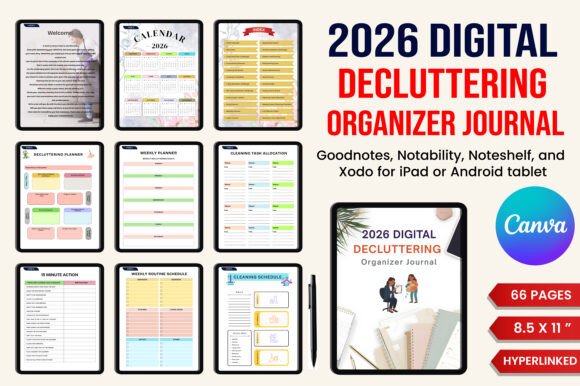
2026 Digital Decluttering Organizer: A Realistic Tool for Sustainable Order
The 2026 Digital Decluttering Organizer is not another generic productivity app or minimalist manifesto—it’s a structured, year-long planning system built around behavioral consistency rather than dramatic overhauls. Unlike digital tools that rely on notifications or AI suggestions, this organizer prioritizes human pacing: daily micro-actions, room-specific scaffolding, and repeated reflection points. Its core design assumes that clutter isn’t just physical—it’s cognitive, emotional, and procedural. That’s why it begins with “Declutter Your Mind First” before moving to drawers and shelves.
How It Differs From Broader Digital Organization Tools
Most digital organization platforms fall into one of two categories: task managers (like Todoist or Microsoft To Do) or habit-tracking apps (like Habitica or Streaks). The 2026 Digital Decluttering Organizer sits between them—not as software, but as a guided framework delivered in digital planner format (PDF or compatible with GoodNotes, Notability, or iPadOS). It doesn’t sync across devices or send reminders, but it does offer something those apps rarely provide: context-aware sequencing.
For example, the 7-Day Declutter Challenge doesn’t ask you to “declutter the kitchen” on Day 1 and “declutter the garage” on Day 2. Instead, it walks through phases: assess → sort → assign → maintain—each applied to one zone at a time. Similarly, the 30-Day Declutter Challenge layers in maintenance habits only after foundational decisions are made, reducing decision fatigue. This contrasts with calendar-based apps where users must manually sequence steps—or worse, abandon plans when motivation dips.
Strengths: Where the 2026 Digital Decluttering Organizer Excels
The 2026 Digital Decluttering Organizer stands out in three practical areas:
- Integration of time scales: It bridges daily action (“5–10 Minute Tasks”) with annual rhythm (“Annual Goals,” “Home Maintenance”). You’re not choosing between urgent and important—you’re scheduling both in relation to each other.
- Role-aware planning: Sections like Family Chore Sheet and Cleaning Task Allocation acknowledge that decluttering in shared spaces requires negotiation, not just execution. It includes space to note who owns which responsibility—not just what needs doing.
- Goal layering: Rather than one vague “declutter my home” objective, it supports eight distinct Decluttering Goals, each with its own tracker and reflection prompt. This allows users to pursue parallel aims—e.g., “reduce paper clutter” while also “create a functional home office”—without conflating progress.
This structure works especially well for people who’ve tried—and stalled on—decluttering before. It replaces open-ended effort (“I’ll clean the basement this weekend”) with bounded, repeatable actions (“Spend 8 minutes sorting mail every Tuesday”). The Daily Planner and Day Broken Down pages reinforce that intentionality without demanding perfection.
Tradeoffs and Limitations to Consider
No tool eliminates friction—but understanding where friction remains helps determine fit. The 2026 Digital Decluttering Organizer has clear boundaries:
- No automation: It won’t auto-schedule recurring tasks or adjust based on your availability. If you rely heavily on calendar syncing or adaptive reminders, this requires manual upkeep.
- Requires self-direction: While highly scaffolded, it doesn’t include video walkthroughs, live coaching, or community support. Users who thrive on external accountability may need to supplement with a group or accountability partner.
- Not designed for rapid reorganization: If you’re preparing for a move next month or hosting guests in two weeks, the step-by-step pacing may feel too slow. Its strength lies in steady accumulation of habit—not emergency triage.
It also assumes a baseline level of digital literacy: comfort with annotating PDFs, organizing files locally, and printing if desired. Those preferring fully tactile experiences (e.g., bound paper journals) may find the digital format less intuitive—though many users report printing select pages (like the Weekly House Cleaning Checklist) for wall or fridge use.
When It Fits—and When It Might Not
The 2026 Digital Decluttering Organizer tends to resonate most with adults aged 28–45 who manage households, juggle multiple roles (parent, professional, caregiver), and have tried linear approaches—like “Marie Kondo-style” single-session sorting—that didn’t stick long-term. One user described using the Before Decluttering section to document current pain points (e.g., “can’t find school permission slips”), then referencing those notes during the Decluttering Goal No-03 review to assess whether systems actually improved access—not just appearance.
Conversely, younger adults (early 20s) building routines from scratch may benefit more from hybrid tools that combine habit tracking with real-time feedback. Similarly, older adults (50+) managing health-related transitions sometimes prefer simplified, large-print physical planners over multi-page digital documents—even if functionally similar.
Another key fit factor is mindset alignment. People drawn to “zero-waste” or “capsule wardrobe” philosophies often seek ideological coherence in their tools. The 2026 Digital Decluttering Organizer doesn’t promote any particular lifestyle doctrine. It’s neutral on consumption ethics—it focuses instead on clarity, capacity, and control. That makes it adaptable but also means users supply their own values framework.
Practical Use: Beyond the Pages
Real-world usage varies, but common patterns emerge. Some users treat the 2026 Full-Year Calendar as a backbone, blocking decluttering windows alongside existing commitments—e.g., “Sunday 9–10 a.m.: Living Room Zone 1 (books + media)” rather than “declutter living room.” Others start small: using the Daily Declutter Challenge for five minutes before checking email, building consistency before scaling up.
The Habit Tracker and Weekly Planner are frequently repurposed beyond decluttering—for medication adherence, hydration goals, or even creative practice. Because the structure separates action from identity (“I’m doing this task” vs. “I am an organized person”), it reduces shame when routines lapse. Missed days are simply noted; the planner invites recalibration, not self-critique.
Importantly, the Control Your Clutter section doesn’t assume clutter equals failure. It frames accumulation as data: “What keeps returning? Why?” That shift—from moral judgment to observational curiosity—is where many users report lasting change begins.
Making Your Decision
If you’re evaluating the 2026 Digital Decluttering Organizer, ask yourself three questions:
- Do I need help sequencing small actions into sustained routines—or do I already maintain consistent habits and just need a place to log them?
- Am I willing to spend 5–10 minutes weekly reviewing progress, adjusting goals, and updating checklists—or would I prefer passive tracking?
- Does my environment involve shared responsibilities (family, roommates, aging parents) where clearly assigned tasks and visible timelines matter more than solo efficiency?
If two or more answers point toward structure, reflection, and shared accountability, the 2026 Digital Decluttering Organizer is likely a strong match. If your priority is speed, integration with existing apps, or minimal setup, a lighter-weight alternative may serve better—for now. What matters most isn’t the tool itself, but how consistently it supports your actual behavior—not the version of yourself you imagine being.