2026 Language Learning System
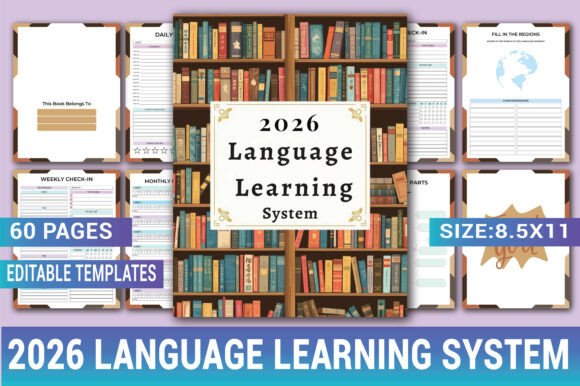
Learning a language isn’t about finding the “perfect” app or waiting for motivation to strike—it’s about showing up, consistently, with clarity and intention. The 2026 Language Learning System is built for that reality. It’s not another passive workbook or digital course. It’s a tactile, thoughtfully structured planner that turns language learning into a daily practice—one grounded in planning, reflection, vocabulary building, grammar awareness, and real-world use.
This isn’t just a calendar with language prompts. It’s a full-year framework designed for adults who value focus, autonomy, and measurable progress—whether you’re brushing up on Spanish before a trip, preparing for bilingual teaching, building content in French for your audience, or exploring Japanese as part of a creative project. Its strength lies in how it integrates four core functions: planning, tracking, structuring knowledge, and applying language. Each supports the others—no isolated exercises, no vague goals.
Creative Uses Beyond Self-Study
Designers and educators often adapt tools like this into collaborative or client-facing resources. For example, a freelance language coach might use the goal planning system to co-create quarterly milestones with students—then annotate those pages with personalized feedback. A blogger documenting their Portuguese journey could repurpose the daily planning pages as a content log: noting which phrases they practiced, what grammar rule they reviewed, and which cultural insight sparked an idea for a post.
Small business owners expanding into multilingual markets have used the vocabulary sections—like “Transportation,” “Emotions,” and “Common Phrases”—to draft authentic, tone-appropriate customer service scripts. One Berlin-based shop owner filled the “Weather” and “Days/Months/Numbers” pages while prepping seasonal email campaigns for Spanish-speaking subscribers—keeping phrasing accurate and culturally resonant without relying on AI translation alone.
For creators, the system doubles as a low-friction research tool. An illustrator developing a bilingual children’s book used the “Body Parts” and “Colors” vocabulary pages to build consistent, labeled visual references—and then cross-referenced verb tenses and adjectives to ensure grammatical alignment across both languages.
How Different Learners Make It Their Own
Beginners benefit most from the scaffolding: starting with the monthly habit tracker to lock in 10 focused minutes per day, using the alphabet sounds section to train ear and mouth simultaneously, and treating the “Five Senses” vocabulary page as a sensory journal—writing one sentence each day describing taste, sound, or texture in their target language.
Intermediate learners lean into the grammar structure pages—not to memorize rules, but to spot patterns. They’ll fill the verb tense grid with three irregular verbs they keep misusing, then write short dialogues applying them correctly. The “Common Mistakes & Corrections” section becomes a living document, updated each week based on tutor feedback or self-review.
Advanced users treat the planner as a refinement engine. They use the “Idioms/Synonyms/Antonyms” pages to deepen nuance—comparing formal vs. colloquial expressions for “I’m tired” in Korean, for instance—or map out rhetorical structures for persuasive writing in Arabic using the conjunctions and adverb pages.
Practical Tips for Consistency and Clarity
Start small—but start specific. Instead of “study Italian,” try “review 5 food-related verbs + write one 3-sentence paragraph about my favorite market.” That fits neatly into a daily planning block and ties directly to the vocabulary and grammar sections.
Use the weekly check-in page not just to assess completion, but to ask: What felt easy? What stalled me? What phrase did I actually use this week? Those reflections feed directly into next week’s priorities—and make progress feel tangible, not abstract.
Keep your planner visible—not buried in a drawer. Place it beside your morning coffee, on your desk, or open on your tablet if using a digital version. Visibility builds habit. And if you miss a day? Flip to the habit tracker, note the gap, then resume—not with guilt, but with adjustment. The system accommodates life; it doesn’t demand perfection.
Why Structure Supports Creativity (Not Limits It)
Some assume rigid systems stifle originality. In practice, the opposite is true. When grammar rules, vocabulary categories, and daily time blocks are already organized, mental energy shifts from *how* to learn to *what* to express. A marketer drafting social posts in Turkish uses the “Common Phrases” section to find natural greetings—then improvises variations based on brand voice. A hobbyist learning Swahili fills the “Emotions” page—and later writes haiku-like micro-stories using only those words.
The planner’s design invites reinterpretation. You don’t have to follow the order. Skip ahead to “Transportation” before “Weather” if you’re planning a commute-themed podcast series. Use the blank margin space for sketching scene-based flashcards. Paste in screenshots of real menus or signs you encounter—and annotate them using the grammar formulas page.
Realistic Results Start With Realistic Habits
The 2026 Language Learning System works because it mirrors how adults actually learn: in fragments, with repetition, through application, and with frequent course correction. There’s no “finish line”—but there are clear markers: completing a month of consistent habit tracking, filling three full vocabulary pages with personal examples, writing five error-checked paragraphs using past-tense verbs.
Its value multiplies when paired with other tools—not replaced by them. Use it alongside a spaced-repetition app (to reinforce what you’ve written), a conversation exchange (to test phrases from the “Practical Language Use” section), or even a simple voice memo app (to record yourself reading aloud from your “Days/Months/Numbers” page).
If you’ve tried language learning before and lost momentum, this system offers something rare: structure that serves your goals—not the other way around. It doesn’t promise fluency in 30 days. It offers something more reliable: a way to learn deeply, steadily, and in a way that fits your rhythm, your work, and your curiosity.