2026 Meditation Journal
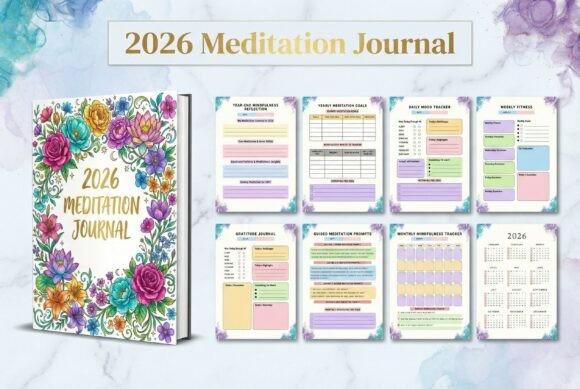
Imagine opening a journal not just to record thoughts—but to anchor yourself in presence, clarity, and intention—every single day of 2026. The 2026 Meditation Journal is built for that: a 120-page interactive PDF designed not as passive filler, but as an active companion for mindful living. It’s not another static planner—it’s a responsive tool, thoughtfully structured to support reflection, growth, and consistency without rigidity.
What makes it stand out isn’t just its length or layout—it’s how it bridges digital flexibility with tangible ritual. With 12 editable Canva pages, you’re not locked into someone else’s vision. You can adapt prompts, swap affirmations, insert your own guided breathing cues, or even embed audio QR codes linking to your recorded meditations. That level of customization matters—especially when you're guiding others or building a signature self-care offering.
More Than a Journal—A Creative Framework
This isn’t only for solo practitioners. Designers and educators use the 2026 Meditation Journal as a starting point for client workbooks—adding branding, custom illustrations, or curriculum-aligned reflections. Bloggers integrate select pages into lead magnets, pairing them with email sequences on habit-building or seasonal mindfulness. Freelancers repurpose editable sections into mini-courses: “30 Days of Morning Grounding,” “Mindful Transitions for Remote Workers,” or “Post-Meeting Reset Routines.”
The US Letter size (8.5 × 11 inches) ensures compatibility across devices and printers—no scaling headaches when moving from screen to paper. And because it includes bleed formatting, creators preparing for KDP or local print runs skip time-consuming prepress fixes. That practical detail alone saves hours—especially if you're launching multiple journals or bundling with other wellness resources.
Real-World Uses Across Roles
Life coaches use the journal’s structure to scaffold client accountability—not by policing progress, but by inviting gentle observation. Instead of asking “Did you meditate today?”, they might prompt: “What sensation showed up first when you sat down? Where did your attention go—and what did that tell you?” Those subtle shifts in language are already embedded in the journal’s prompts, making facilitation feel intuitive, not prescriptive.
Educators and workshop leaders extract individual pages—like the weekly intention tracker or breath-awareness log—to use as handouts. They add school-specific themes (“Focus Before Exams,” “Transitioning Between Classes”) while preserving the journal’s calm visual rhythm. No need to reinvent; just refine.
Small business owners and content creators treat the editable Canva pages like modular assets. One entrepreneur layers her logo and color palette over the gratitude spread, then sells it as a standalone digital download alongside her podcast. Another bundles three edited pages with a Notion template and a 15-minute audio guide—creating a low-cost, high-perceived-value entry product.
Designing With Purpose—Not Just Aesthetics
Clarity starts with constraints. The 2026 Meditation Journal avoids overwhelming users with blank space or vague directives. Each section has quiet intention: daily check-ins ask *what supported your calm today*, not just *how did you feel*. Monthly reflections invite comparison—not for judgment, but pattern recognition (“When did stillness come easiest? What preceded it?”).
If you’re adapting it for clients, keep edits purposeful. Replace generic prompts with ones tied to their goals: “What boundary did I honor this week?” for burnout recovery, or “When did I pause before reacting?” for emotional regulation work. Consistency doesn’t mean uniformity—it means returning to the same thoughtful architecture, again and again, with room to evolve.
From Digital to Physical—Without Compromise
Because the file is print-ready with bleed, designers don’t have to choose between digital convenience and physical impact. Test prints on matte paper reveal how well the subtle line art holds up. Spot UV finishes on cover pages? Possible. Staple-bound versions for retreat handouts? Straightforward. Even hobbyists printing at home find the margins forgiving—no critical text gets cut off.
And unlike many digital journals that fade after a few weeks, this one builds momentum. The 120-page count spans full months—not rushed spreads, not sparse gaps. It gives space for slowness, for re-reading past entries, for noticing how your relationship to stillness changes across seasons.
Keeping It Authentic—For You and Your Audience
Authenticity isn’t about raw confession—it’s about relevance. When you customize the 2026 Meditation Journal, ask: Does this reflect the real rhythms of my audience’s life? A freelancer juggling deadlines needs different scaffolding than a teacher managing classroom energy. A parent seeking micro-moments of calm needs prompts that fit between school drop-offs—not hour-long retreats.
That’s why the editable Canva pages matter beyond aesthetics. They let you shift tone: soften language for teens, add bilingual headers for multilingual communities, or simplify layouts for neurodivergent users. Small changes—larger resonance.
Getting Started—No Overwhelm Required
You don’t need to redesign everything at once. Try this:
- Week 1: Print just the daily log and morning intention page. Use them offline—no apps, no notifications.
- Week 2: Open one Canva page. Change three words in a prompt to match your current focus—e.g., swap “gratitude” for “small wins.”
- Week 3: Share one adapted page with a colleague or client—ask what resonates, what feels missing.
That’s how sustainable integration begins—not with overhaul, but with observation, iteration, and alignment.
The 2026 Meditation Journal works because it meets people where they are: digitally fluent but craving depth, busy but longing for stillness, creative but needing structure. It doesn’t ask you to become someone new. It supports who you already are—while quietly expanding what’s possible.