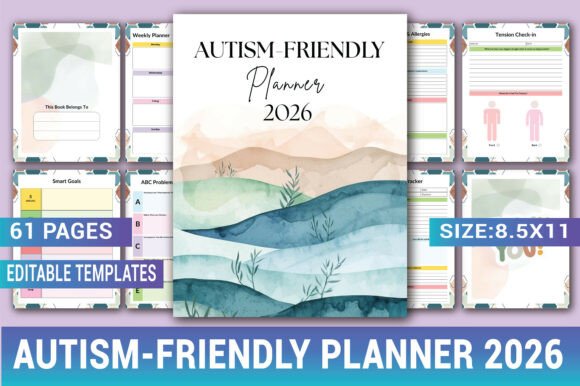
Autism-Friendly Planner 2026
If you’ve ever stared at a blank calendar and felt your chest tighten—not from urgency, but from the sheer weight of *how* to begin—this planner was made for you. The Autism-Friendly Planner 2026 isn’t just another yearly organizer. It’s a quiet, intentional companion designed with autistic cognition in mind: fewer visual distractions, predictable layouts, space for sensory awareness, and tools that honor how energy, attention, and communication actually work—not how neurotypical systems assume they should.
It’s built on three core understandings: first, that organization isn’t about rigid control—it’s about reducing uncertainty so mental bandwidth can go toward what matters. Second, that self-knowledge is foundational: tracking masking, sensory shifts, or emotional patterns isn’t clinical—it’s grounding. Third, that empowerment grows when structure supports autonomy, not overrides it. That’s why every page—from the monthly overview to the snack-idea log—holds room for both clarity and flexibility.
Why This Planner Fits Different Lives (Without Forcing Fit)
A freelance graphic designer in their late twenties might open the Autism-Friendly Planner 2026 looking for help managing irregular deadlines and client communication fatigue. They’ll likely turn first to the Communication Masking Support pages—not as a diagnostic tool, but as a way to name what’s draining them after back-to-back Zoom calls. The weekly layout gives them a visual anchor without demanding perfection; they can block “low-sensory hours” in pale green and leave other slots intentionally blank. For them, ease of use and sensory-friendly design aren’t nice-to-haves—they’re non-negotiable for sustainability.
A high school special education teacher, meanwhile, may download the planner to adapt parts for her students—or to model planning strategies she teaches. She values the Routine Behavior Trackers and Therapy-Inspired Worksheets not just for personal use, but because they’re clinically grounded yet accessible. She prints select pages for small-group work, using the ABC problem-solving template during social-emotional learning blocks. For her, reliability and educational alignment matter most—she needs tools that hold up under classroom use and align with IEP goals, not flashy extras.
A small business owner launching a neurodivergent-led coaching practice might use the Goals Challenges section differently: not for personal habit-building, but as a framework to co-create 90-day roadmaps with clients. The SMART goal templates help translate big intentions (“build confidence in meetings”) into concrete, measurable steps—and the reflection prompts invite deeper conversation. Here, commercial value lies in usability *with others*, not just solo efficiency. She also checks whether the PDF allows clean, professional printing—because some clients prefer physical copies she can annotate together.
What Beginners Notice First (and Why That Matters)
If you’re new to structured planning—or have tried planners before and abandoned them within weeks—the Autism-Friendly Planner 2026 meets you where you are. There’s no pressure to fill every box. The monthly calendars use clear typography and generous white space. Weeklies include optional checkboxes—not checklists that scold. Even the “meal planning” section avoids prescriptive recipes; instead, it offers sensory-friendly snack ideas (crunchy, cool, low-odor), food sensitivity logs with simple yes/no/maybe ratings, and mindful eating notes that ask, “Did this feel calming or taxing?” not “Did you eat enough protein?”
Beginners often prioritize psychological safety over feature count. A cluttered digital app might promise reminders and analytics—but if opening it triggers decision fatigue, it won’t last. This planner’s printable PDF format removes device dependency, reduces screen time, and lets users start exactly where their energy is: maybe just tracking one daily anchor (e.g., “water by 10 a.m.”) for two weeks before adding anything else.
Where Experienced Users Go Deeper
Those already familiar with self-tracking tools may appreciate how the Autism-Friendly Planner 2026 layers insight without overload. The meltdown tracker doesn’t just log intensity—it invites gentle inquiry: “What happened 90 minutes before? Was there a sensory shift? A change in routine? A hidden demand?” Paired with the coping plan worksheet, it becomes less about fixing and more about pattern recognition. Over months, someone might notice their “masking peaks” align with specific meeting types or environments—and adjust boundaries accordingly.
The Reflection & Journaling Notes section stands out here too. Prompts like “When did I feel most like myself this week?” or “What did I protect today—and why?” avoid vague positivity. They support identity-affirming reflection, especially valuable for adults who spent years adapting to fit unseen expectations. For experienced users, long-term usefulness hinges on depth—not novelty—and this planner rewards consistent, low-pressure engagement.
Practical Considerations Beyond the Pages
The Autism-Friendly Planner 2026 arrives as a high-quality printable PDF—no subscriptions, no login walls. That means you own it. You decide whether to print the full year, just the quarterly sections, or even single pages to test before committing. You can bind it, hole-punch it, tuck it into a notebook, or keep it digital on a tablet with a stylus. Flexibility isn’t an add-on; it’s baked in.
Quality shows in subtle ways: consistent spacing between lines (reducing visual crowding), sans-serif fonts optimized for readability, grayscale-friendly design (so printing is affordable), and logical tab order for screen readers. It’s not about aesthetics alone—it’s about removing friction at every touchpoint.
For creators, educators, or therapists: yes, you can use selected pages in your work—ethically and respectfully. The license permits personal and professional use with attribution, making it viable for workshops, therapy handouts, or student resource packs—no need to reinvent foundational tools.
Does It Match Your Needs Right Now?
Ask yourself: Do you need predictability more than productivity? Are you tired of planners that assume constant energy, linear focus, or verbal fluency? Do you want to understand your rhythms—not override them?
If your goal is gentler self-management—not hustle culture repackaged—you’ll likely find resonance here. If you’re evaluating tools for a team, classroom, or client group, look at how easily pages can be adapted, shared, or scaffolded—not just how many features exist.
This isn’t a cure-all. It won’t eliminate burnout or replace access to support. But it *can* be a steady, compassionate place to begin again—on your terms, in your time, with your nervous system fully included.