FUTURE ME – GUIDED JOURNAL for VISION
At its core, FUTURE ME – GUIDED JOURNAL for VISION is a reflective tool designed to bridge the gap between where you are now and who you’re becoming. It’s not a planner focused on daily tasks or a habit tracker measuring consistency—it’s a space for future-self inquiry. The journal invites deliberate pauses, structured yet open-ended prompts, and gentle scaffolding for visioning work that often gets sidelined in busier self-development routines.
What sets this journal apart from other guided journals
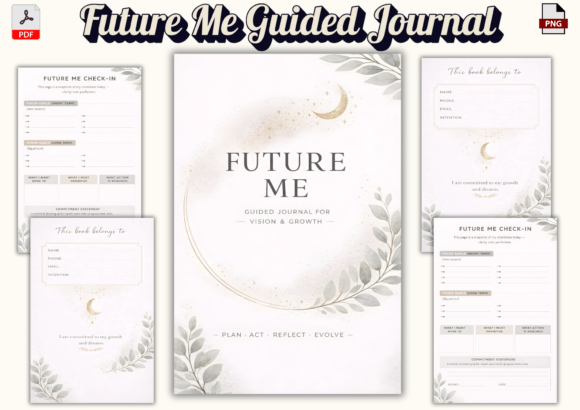
Many guided journals emphasize either action (e.g., “do this every morning”) or emotion (e.g., “write three things you’re grateful for”). FUTURE ME – GUIDED JOURNAL for VISION sits deliberately in the middle: it supports both clarity and commitment without conflating speed with progress. Its 59-page layout avoids overwhelm while offering enough depth to sustain reflection across weeks or seasons—not just days. The vertical 6 × 9 inch format feels substantial but portable; the botanical minimalism isn’t decorative filler—it serves cognitive ease, reducing visual noise so attention stays on internal content.
Unlike journals built around rigid timelines (e.g., 90-day challenges) or prescriptive goal frameworks (SMART, OKRs), this one prioritizes narrative coherence. Pages like “Letter to Your Future Self” and “This Book Belongs To” reinforce ownership and continuity—subtle but meaningful design choices that support long-term engagement. The inclusion of both short- and long-term goal planning pages acknowledges that vision evolves at different speeds: some intentions crystallize quickly; others need months of quiet tending before they’re ready to act on.
How it compares with common alternatives
When evaluating tools for personal growth, people often consider digital apps, printable PDF planners, undated physical journals, or audio-based reflection systems. Each has tradeoffs—and FUTURE ME – GUIDED JOURNAL for VISION occupies a distinct niche within that landscape.
- Digital journaling apps (e.g., GoodNotes, Notability): These offer flexibility and searchability but can lack tactile grounding. While FUTURE ME – GUIDED JOURNAL for VISION is compatible with tablets, its intentional spacing and page-by-page flow discourage scrolling or jumping. That structure helps reduce decision fatigue—a real benefit for users who’ve tried digital journaling but found themselves distracted by formatting options or notifications.
- Undated blank or dotted journals: These provide total freedom but little direction. For someone early in their reflection practice—or returning after a long break—the absence of prompts can feel paralyzing. FUTURE ME – GUIDED JOURNAL for VISION offers just enough scaffolding to begin without dictating outcomes. It doesn’t tell you what to want—it asks questions that help uncover what already matters.
- Goal-focused planners (e.g., quarterly review systems or productivity trackers): These excel at execution but often under-prioritize identity-level alignment. You might hit all your targets and still feel disconnected from your deeper values. FUTURE ME – GUIDED JOURNAL for VISION foregrounds intention-setting *before* action planning, helping surface misalignments early—like pursuing a promotion that conflicts with desired lifestyle rhythms.
Strengths and realistic limitations
The journal’s greatest strength lies in its consistency of tone and purpose. Every prompt circles back to one question: Who is the version of me I’m growing toward? That focus makes it especially useful during transitions—career shifts, life resets, post-burnout recalibration, or even seasonal changes in energy and priorities. Users report returning to earlier entries not to measure “progress” in linear terms, but to notice subtle shifts in language, confidence, or boundaries.
That said, it’s not optimized for rapid iteration or collaborative use. If you rely heavily on shared accountability (e.g., co-journaling with a coach or partner), the format leans private and individual. Similarly, if your goals require frequent data tracking—weekly metrics, habit streaks, or budget line items—you’ll likely pair this journal with another tool rather than replace it entirely.
It also assumes a baseline willingness to sit with ambiguity. Some prompts ask you to describe your future self before you have full clarity—and that’s by design. But readers who prefer concrete, immediate outputs may find certain sections feel too open-ended at first. That discomfort often softens with repeated use, but it’s worth acknowledging upfront.
When FUTURE ME – GUIDED JOURNAL for VISION fits best
This journal tends to resonate most strongly with people who:
- Already journal occasionally but want more thematic cohesion around identity and direction;
- Feel pulled in multiple directions and need help distinguishing urgent from essential;
- Are comfortable with analog or hybrid workflows (writing by hand, then digitizing notes);
- Value aesthetics as part of function—calming visuals that support sustained attention, not distract from it;
- Prefer reflection that builds gradually, not through intensive sprints or timed exercises.
A practical example: A 34-year-old graphic designer paused freelance work for six months to care for an ill parent. Returning to creative work, she felt disconnected from her professional identity—not because her skills had faded, but because her definition of success had quietly shifted. Using FUTURE ME – GUIDED JOURNAL for VISION, she spent two weeks revisiting prompts about “what energizes me now” versus “what used to energize me.” That process didn’t produce a new business plan—but it clarified why she no longer wanted client acquisition as her primary metric. Instead, she redesigned her offerings around sustainability and mentorship. The journal didn’t give her answers; it held space for the questions to settle.
When another option might serve better
If your current need is highly tactical—say, launching a side hustle in 90 days or preparing for a certification exam—FUTURE ME – GUIDED JOURNAL for VISION complements those efforts but shouldn’t replace them. You’d likely pair it with a project planner or milestone tracker. Likewise, if you thrive on external feedback loops (e.g., weekly check-ins with a peer group), a journal alone won’t fulfill that relational need—even a well-designed one.
For readers new to reflection altogether, starting with something even lighter—like a single-page weekly review template—may build confidence before committing to a full journal. And if portability is non-negotiable (e.g., constant travel with limited access to pens or flat surfaces), a mobile-first app with voice-to-text might be more sustainable than a printed or tablet-based journal—even one as thoughtfully formatted as FUTURE ME – GUIDED JOURNAL for VISION.
Making a grounded choice
Choosing a journal isn’t just about aesthetics or page count—it’s about matching structure to your current capacity and intent. FUTURE ME – GUIDED JOURNAL for VISION works best when you’re ready to slow down, not catch up. It rewards patience, honors nonlinear growth, and treats vision as something cultivated—not captured. Its value emerges over time: in the way earlier entries reveal patterns you hadn’t named, or how rereading a letter to your future self reshapes present decisions.
No single tool guarantees transformation. What FUTURE ME – GUIDED JOURNAL for VISION offers is fidelity—to your own pace, your evolving definitions, and the quiet work of becoming. That kind of consistency, when paired with honest engagement, often matters more than any feature list.