🌙 Astrology Shadow Work Journal – 100: A Practical Framework for Natal Chart–Guided Self-Inquiry
Shadow work—confronting the unconscious, disowned, or suppressed parts of the self—is not a trend. It’s a time-tested psychological practice rooted in Jungian theory and increasingly validated by modern trauma-informed therapy, neuroscience, and somatic approaches. When paired with astrology—not as fortune-telling, but as a symbolic language mapping inner terrain—the process gains structure, resonance, and personal specificity. The 🌙 Astrology Shadow Work Journal – 100 transforms abstract concepts like “the shadow” into tangible, chart-anchored reflections. It does so by grounding each prompt in your natal chart: the precise configuration of planets, signs, houses, aspects, and nodes at your moment of birth.
Why Natal Charts Provide an Unmatched Lens for Shadow Exploration
Your birth chart is not a cosmic script dictating fate—it’s a psychological blueprint. Each placement carries archetypal meaning shaped by context: a Mars in Pisces behaves differently in the 12th house than in the 1st; a square between Saturn and Venus reveals relational patterns distinct from a trine. These configurations often reflect where energy gets blocked, overcompensated, denied, or projected—classic hallmarks of shadow material. For example:
- A person with Chiron in the 7th house may unconsciously attract partners who mirror their unhealed wounds around trust—yet never recognize this as a reflection of their own early relational conditioning.
- Someone with Pluto conjunct the Ascendant might wield intense personal power but avoid acknowledging how fear of vulnerability drives control behaviors in close relationships.
- A Moon-Saturn opposition can manifest as chronic self-criticism disguised as “realism,” masking deep-seated fears of emotional inadequacy inherited from early caregiving dynamics.
These aren’t diagnoses—they’re entry points. The 🌙 Astrology Shadow Work Journal – 100 leverages this precision. Rather than asking generic questions like “What am I afraid of?”, it asks: “Where in your chart do you see themes of restriction or responsibility tied to emotional safety—and how has that shaped your capacity to receive care?” That specificity invites honesty, bypasses defensiveness, and builds self-trust through evidence-based self-observation.
How the 100 Prompts Are Structured for Progressive Integration
The journal avoids linear “fix-it” logic. Instead, its prompts unfold across four interwoven dimensions: planetary function, house domain, aspectual tension, and nodal evolution. This mirrors how shadow material operates—not in isolation, but in dynamic relationship.
Early prompts focus on anchoring awareness. You might explore your Sun sign’s core identity expression—and then immediately contrast it with your 7th house ruler’s sign and condition. That juxtaposition surfaces discrepancies between how you present yourself and how you relate to others: a classic site of projection and denial. Later prompts deepen into aspect patterns. A T-square involving Mercury, Neptune, and Pluto, for instance, invites inquiry into where truth-telling feels dangerous, where information gets distorted, and what remains unspeakable—even to oneself.
Houses serve as lived environments: the 4th (roots, family legacy), 6th (daily habits, service), 8th (shared resources, intimacy boundaries). Prompts here ask not just “What happened?” but “Where in my chart does this pattern live—and how does it activate under stress?” One user with Saturn retrograde in the 4th house noted how childhood messages about “not burdening others” now show up as difficulty delegating at work—a direct line from ancestral survival strategy to present-day burnout.
The North and South Nodes appear in targeted prompts that distinguish comfort zones (South Node) from growth edges (North Node). A South Node in Gemini in the 3rd house might reveal over-reliance on intellectualizing feelings—while the North Node in Sagittarius in the 9th calls for embodied philosophical inquiry: “What belief systems protect me from feeling uncertain—and what would happen if I sat with not knowing?”
Real-World Applications Across Lived Contexts
This isn’t theoretical. Professionals use the 🌙 Astrology Shadow Work Journal – 100 to interrupt reactive leadership patterns. An educator with Uranus conjunct the Midheaven realized her impatience with rigid curricula wasn’t just frustration—it reflected a lifelong tension between innovation (Uranus) and authority structures (Midheaven). Journaling revealed how she’d internalized rebellion as identity, limiting her ability to collaborate systemically. Subsequent prompts helped her reframe disruption as stewardship—not rejection.
Creatives find clarity when blocks feel inexplicable. A writer with Venus-Neptune square described years of abandoning projects mid-draft, blaming “lack of discipline.” Through journal prompts targeting Venus (values, pleasure), Neptune (dissolution, idealism), and the square’s friction, she uncovered a deeper fear: that authentic expression would expose unworthiness. The chart didn’t excuse the behavior—it named its origin, making repair possible.
Therapists and coaches integrate select prompts ethically into sessions—never as diagnosis, but as collaborative exploration tools. One clinician shared how using the Moon-in-Scorpio prompt (“When did I first learn that emotions must be hidden to stay safe?”) helped a client connect current hypervigilance to unspoken family secrets, bypassing years of surface-level coping strategies.
Design Choices That Support Depth, Not Distraction
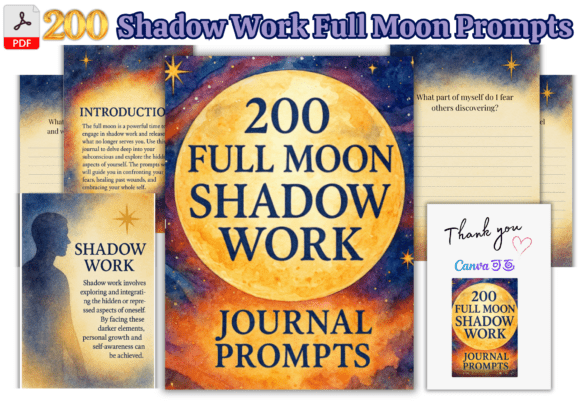
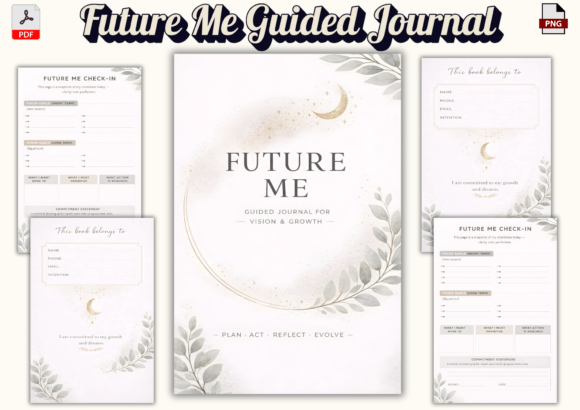
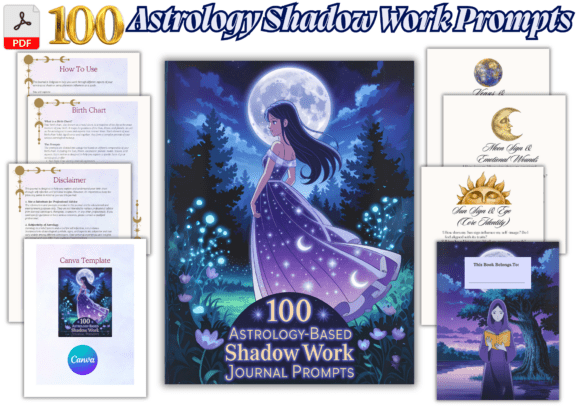
The physical and digital architecture of the 🌙 Astrology Shadow Work Journal – 100 serves intentionality. Its 8.5 x 11 PDF format provides ample white space—critical for nonlinear thought. Unlike tightly formatted planners, this layout resists rushing. Lines are generous; margins invite marginalia, sketches, or astrological glyphs drawn by hand. The editable Canva template isn’t about aesthetics—it’s about embodiment. Changing colors, adding symbols, or rearranging sections makes the tool feel claimed, not consumed.
The “This Book Belongs To” page isn’t ceremonial. Handwriting your name initiates psychological ownership—a subtle but vital step before confronting material that may feel threatening. And the 24-page expansion (beyond standard 10–12 page journals) reflects understanding: shadow work isn’t resolved in a week. It requires iteration. One prompt may yield insight today; revisiting it three months later—after life shifts—can unlock entirely new layers.
Who Benefits—and Who Might Need Additional Support
This journal serves anyone with foundational astrological literacy: knowing your Sun, Moon, and rising signs—or having access to a free natal chart (e.g., Astro.com). It’s especially valuable for those who’ve hit limits with generic journaling or talk therapy alone. But it’s not a replacement for clinical care. Individuals experiencing active psychosis, severe dissociation, or recent trauma should engage with these prompts alongside a qualified mental health professional. The journal includes no crisis resources—not because it assumes safety, but because integration requires stable ground. Its power lies in gentle, sustained excavation—not emergency intervention.
Hobbyists appreciate its accessibility: no need to memorize dignities or decans to begin. Educators use it to model metacognition—showing students how self-awareness frameworks evolve with complexity. Researchers studying symbolic cognition cite its structured yet open-ended prompts as ideal for qualitative data collection on meaning-making processes. Business owners report improved decision-making after identifying how their Mars-Jupiter conjunction in Capricorn drives both strategic ambition and risk-aversion disguised as prudence.
Building Sustainable Practice Beyond the Page
The most transformative use of the 🌙 Astrology Shadow Work Journal – 100 emerges not from completion, but from return. Revisiting earlier prompts after planetary transits—like Saturn returning to its natal position, or Pluto crossing the IC—reveals how understanding deepens with time and experience. One user tracked her Saturn return journey across three journal iterations: initial resistance (“I don’t have time for this”), mid-return exhaustion (“Why does everything feel like a test?”), and post-return clarity (“This isn’t punishment—it’s initiation into grounded authority”).
Digital users benefit from searchable PDF features—tagging prompts by theme (e.g., “boundaries,” “self-worth,” “family”) creates personalized reference maps. Print users often bind completed pages into physical volumes, creating evolving archives of inner development—tangible proof that shadow work isn’t about eradication, but integration.
Ultimately, this journal succeeds because it refuses to oversimplify. It doesn’t promise enlightenment in 100 days. It offers something more durable: a method for meeting yourself—planet by planet, house by house, aspect by aspect—with curiosity instead of judgment. In a world saturated with quick fixes and external validation, that kind of patient, chart-rooted attention remains quietly revolutionary.