How the 2026 Grief Therapy Journal Integrates Clinical Insight with Daily Lived Experience
Grief is not a linear process—it’s a dynamic, layered experience shaped by biology, culture, memory, identity, and time. In clinical settings, therapists often observe that individuals benefit most when therapeutic frameworks meet real-world rhythms: the quiet morning after a difficult dream, the fatigue that settles mid-afternoon, the unexpected surge of emotion triggered by a scent or song. The 2026 Grief Therapy Journal was conceived precisely at this intersection—where evidence-informed grief theory meets the unstructured cadence of daily life. Rather than imposing rigid timelines or prescriptive outcomes, it offers scaffolding: gentle structure for those who feel adrift, spaciousness for those needing silence, and intentional prompts for those ready to explore meaning.
Design Rooted in Grief Research, Not Just Aesthetics
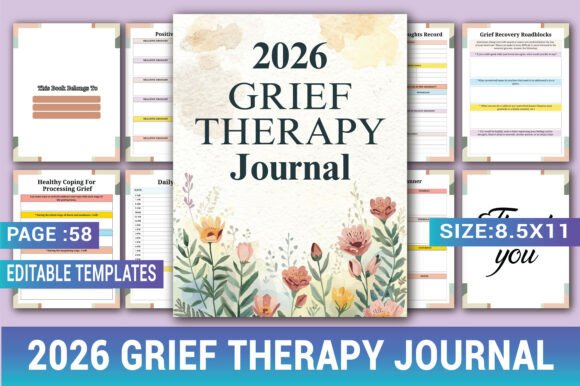
Contemporary grief models—such as Worden’s Tasks of Mourning, Stroebe and Schut’s Dual Process Model, and Neimeyer’s Constructivist Narrative Therapy—emphasize oscillation: moving between loss-oriented activities (e.g., remembering, crying, confronting absence) and restoration-oriented activities (e.g., re-engaging with routines, building new roles, attending to practical needs). The 2026 Grief Therapy Journal mirrors this natural rhythm through its dual-layered layout system. Daily pages include both a “Loss Reflection” prompt—like *“What feeling showed up today that surprised you? Where did you notice it in your body?”*—and a “Restoration Anchor”—such as *“One small thing I did today just for myself.”* This isn’t arbitrary design; it reflects decades of longitudinal research showing that flexibility in coping strategies correlates strongly with long-term adaptation.
Unlike generic wellness journals that treat grief as a mood to be managed, this journal embeds neurobiological awareness. Mood tracking isn’t limited to emoji-based scales. Instead, it pairs emotional labels with somatic checklists (“tight shoulders,” “shallow breathing,” “low energy”) and contextual notes (“after phone call with sibling,” “during grocery shopping”). This supports interoceptive awareness—a skill repeatedly linked to improved emotional regulation in trauma- and grief-informed care.
Practical Integration Across Diverse Lived Realities
The utility of the 2026 Grief Therapy Journal extends beyond individual use. Educators incorporate its memory ritual pages into high school health curricula when discussing death literacy. Hospice social workers recommend it alongside discharge planning—not as a replacement for therapy, but as a continuity tool between sessions. Researchers studying complicated grief have adapted its weekly reflection templates for qualitative data collection, citing their balance of open-ended depth and standardized structure.
For professionals navigating workplace loss—such as teachers after a student’s death or healthcare teams following patient fatalities—the journal’s “Support Connection Sections” provide non-clinical yet clinically sound scaffolding. Pages invite users to map emotional support networks visually (not just list names), noting *who listens without fixing*, *who shares similar experiences*, and *who needs space right now*. This acknowledges that grief reshapes relational ecosystems—and that healthy boundaries are part of healing, not avoidance.
Hobbyists and creators find unexpected resonance in its “Memory Ritual Pages.” A ceramicist used the goodbye letter template to draft words she spoke aloud while glazing a memorial mug. A musician adapted remembrance prompts into lyric fragments for a solo album. These aren’t deviations from the journal’s purpose—they affirm its core principle: grief integration happens through expression, not just introspection.
Temporal Architecture: Why 2026 Matters
The choice of “2026” is deliberate—not merely calendrical, but conceptual. Grief unfolds across timeframes that defy calendar logic: the first holiday season without someone (often 3–6 months post-loss), the return of seasonal cues (a birthday, a shared vacation month), the subtle shifts that emerge around the one-year mark. The 2026 Grief Therapy Journal anticipates these inflection points. Its yearly calendar highlights blank spaces for personal anniversaries—not just fixed dates like birthdays, but *“first time driving past our favorite café,”* *“first snowfall since they passed.”* Monthly spreads include “Threshold Notes” sections, prompting reflection on what has shifted—not in grand ways, but in micro-changes: sleep patterns, appetite preferences, tolerance for noise or solitude.
Daily planners avoid over-scheduling. Time blocks are labeled “Anchor,” “Tend,” and “Release”—not “Work,” “Errands,” or “Leisure.” This language shift matters. An “Anchor” might be five minutes of grounding breathwork before opening email. “Tend” could mean watering a plant gifted at the funeral. “Release” may involve scribbling unsent thoughts onto a tear-out page. These categories normalize variation: some days hold only Anchors; others flow fluidly across all three. That flexibility reduces the shame many feel when grief disrupts productivity norms.
Self-Care as Relational, Not Just Individual
Self-care sections in the 2026 Grief Therapy Journal resist the commodified version often seen in mainstream wellness culture. There’s no pressure to “optimize” rest or “hack” resilience. Instead, self-care logs ask: *“What helped me feel less alone today?”* or *“When did I notice my body trying to protect me?”* Gratitude journaling avoids forced positivity. Prompts include *“One thing my grief has taught me about care”* and *“A boundary I honored—even quietly.”*
Meditation logs don’t assume seated stillness. Options include “walking meditation,” “sound bath (even if just rain against the window),” and “silence with tears allowed.” This honors somatic realities: many people in acute grief cannot sit still, and equating meditation solely with stillness can alienate rather than support.
Emotional Tracking That Honors Complexity
The mood tracker avoids flattening nuance. Rather than asking users to assign a single emotion per day, it invites layering: *“Primary feeling,” “Underlying feeling,” “Physical sensation,” “Trigger (if known),” “Response (what did you do?).”* One user noted in her reflection space: *“‘Sad’ doesn’t cover it—I felt sad, yes, but also furious at how ordinary the world looked while mine had cracked. My jaw was clenched all afternoon. I didn’t know why until I wrote it down.”*
This granularity serves multiple functions. Clinically, it builds emotional granularity—the ability to distinguish between closely related states like grief, loneliness, exhaustion, and resentment. Psychologically, it interrupts the narrative that “I’m just broken.” Practically, it reveals patterns: certain symptoms peak during transitions (e.g., Sunday evenings), or specific rituals consistently lower anxiety (e.g., lighting a candle while listening to a voicemail). These insights inform both self-management and collaborative conversations with therapists or physicians.
Reflection Space as Cognitive Holding Environment
The open journal pages—scattered throughout, not confined to the back—are intentionally unruled and lightly textured. Research in expressive writing shows that physical writing (versus typing) activates different neural pathways associated with memory processing and emotional regulation. The paper quality supports pen, pencil, or even light watercolor washes—acknowledging that some emotions arrive as color, shape, or gesture before language.
Therapists report clients using these pages to draft session notes *before* appointments—clarifying questions or themes—or to record insights *after*, preserving fragile realizations that might otherwise dissolve by morning. Educators use them for guided free-writing exercises, asking students to respond to prompts like *“What does ‘moving forward’ mean in my body right now?”* without grading or correction.
Considerations for Intentional Use
While the 2026 Grief Therapy Journal is designed for broad accessibility, its effectiveness depends on alignment with user needs. It is not intended as a substitute for clinical intervention when symptoms include persistent suicidal ideation, dissociation, or functional impairment lasting more than two weeks. Its strength lies in complementarity: supporting work begun in therapy, extending mindfulness practice into daily life, or offering structure during periods when formal support isn’t available.
Some users initially resist the “planner” aspect, associating scheduling with pressure. The journal addresses this by framing structure as *invitation*, not obligation. Weekly layouts include a “Skip This Week” checkbox—validated by grief counselors who note that permission to disengage reduces resistance to returning later. Similarly, memory ritual pages offer multiple entry points: write, draw, paste a photo, leave blank, or revisit in six months.
Business owners and HR professionals have adapted its framework for bereavement support policies—not by distributing journals wholesale, but by integrating its principles into manager training: teaching leaders to recognize restoration-oriented needs (“Can I take something off your plate this week?”) alongside loss-oriented ones (“Would you like space to talk about them?”).
Conclusion Without Closure
The 2026 Grief Therapy Journal does not promise resolution. It makes no claim to “fix” grief. What it offers is fidelity—to the science of mourning, to the variability of human response, and to the quiet dignity of showing up, day after day, with whatever is present. Its value emerges not in completion, but in engagement: the underlined phrase, the tear-stained margin, the date circled twice, the page left intentionally blank. In a world increasingly oriented toward speed, metrics, and measurable outcomes, its greatest contribution may be this: honoring slowness as a legitimate mode of healing.