Prompts Collection for Children’s Book: A Practical Guide for Writers, Educators, and Creative Families
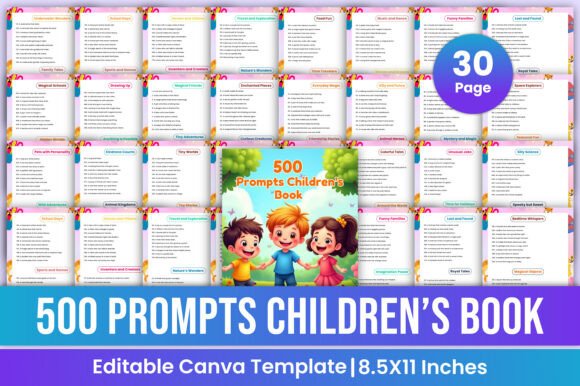
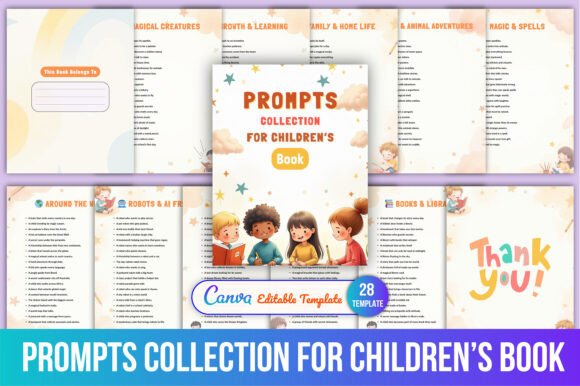
When developing stories for children, the challenge isn’t usually a lack of passion—it’s the daily friction of starting fresh. A blank page, shifting age-level expectations, curriculum alignment, or the need to balance entertainment with emotional resonance can slow even experienced creators. The Prompts Collection for Children’s Book addresses this friction directly: it’s a curated set of 500 prompts, organized across 25 thematic categories (like “Emotions,” “Nature,” “Time Travel,” and “Bedtime Tales”), each containing 20 distinct, age-appropriate story starters.
What sets this resource apart isn’t just volume—it’s intentional scaffolding. Each prompt is designed to invite open-ended thinking while remaining grounded in developmental appropriateness. For example, under the “Friendship” topic, you’ll find prompts like *“Your character finds a notebook that only writes back when they tell the truth—what happens when a friend asks for help hiding something?”* Rather than prescribing plot or tone, it introduces ethical nuance, voice, and relational stakes—all within language accessible to early elementary writers or listeners.
How It Fits Into the Broader Landscape of Creative Resources
Many educators and authors rely on general writing prompt banks, AI-generated suggestions, or free online lists. While useful in some contexts, those options often lack consistency in reading level, thematic cohesion, or pedagogical intention. The Prompts Collection for Children’s Book differs by design: every prompt assumes a child-centered lens—not as an afterthought, but as the organizing principle. It avoids abstract metaphors, overly complex syntax, or cultural assumptions that might alienate diverse readers.
Compare this to widely used classroom tools like story dice or random word generators: those spark quick ideas but rarely support sustained development—no built-in progression from idea to draft, no guidance on pacing or character motivation. In contrast, the Prompts Collection for Children’s Book includes structural variety: some prompts focus on sensory detail (“Describe the sound your pet made the first time it saw rain”), others invite perspective shifts (“Write a letter from your backpack to your teacher”), and several build emotional literacy (“What does courage feel like in your hands? Your feet? Your voice?”).
Strengths: Where This Resource Delivers Consistently
- Thematic coherence: Grouping prompts into 25 topics means users can match them to lesson plans, seasonal themes, SEL goals, or publishing categories—without needing to filter or reorganize.
- Format flexibility: The inclusion of editable Canva templates, print-ready PDFs, and JPG previews supports varied workflows—whether you’re projecting prompts during circle time, printing mini-cards for writing centers, or customizing visuals for neurodiverse learners.
- Developmental awareness: Prompts avoid infantilizing language while respecting cognitive and linguistic limits of ages 4–10. There’s no forced rhyme, no reliance on pop-culture references that date quickly, and minimal dependence on visual context—making them effective for oral storytelling, dictation, or independent writing.
- Scalability: Because each topic contains 20 prompts, users can rotate through variations without repetition fatigue—valuable for weekly writing units, summer camp activities, or long-term author practice.
Tradeoffs and Realistic Limitations
No single resource replaces deep knowledge of child development, literary craft, or classroom dynamics—and the Prompts Collection for Children’s Book doesn’t claim to. It offers strong raw material, but not instruction. You won’t find embedded teaching notes, rubrics, differentiation strategies, or genre-specific guidance (e.g., how to structure a cumulative tale versus a problem-solution picture book). That’s intentional: it keeps the tool lightweight and adaptable, but it also means users must bring their own pedagogical or editorial framework.
Similarly, while the collection spans imaginative territory—from robots to emotions—it doesn’t prioritize representation by default. Prompts are inclusive in tone and avoid stereotypes, but they don’t systematically rotate cultural contexts, family structures, or ability narratives unless prompted by the theme (e.g., “Family Stories” invites variation, but “Magical Creatures” does not inherently foreground Indigenous cosmologies or disability-led worldbuilding). Users seeking intentional diversity integration may need to adapt prompts or pair them with supplementary resources.
Best-Fit Scenarios: When This Collection Aligns Well
The Prompts Collection for Children’s Book works especially well when:
- You’re drafting multiple manuscripts and need reliable, non-repetitive inspiration—particularly if you write across age bands (e.g., board books, early chapter books, and picture books) and want prompts calibrated for different language demands.
- You teach in a mixed-age or multi-grade setting and need prompts that scale—some students can illustrate and dictate responses; others draft independently; all engage with the same core idea.
- You facilitate family story nights or library programs and want ready-to-go, low-prep prompts that encourage collaborative telling—not just individual writing.
- You’re building a personal creative habit and benefit from thematic constraints. Having 20 takes on “Weather Wonders,” for instance, helps explore nuance rather than chasing novelty.
When Another Option Might Serve Better
This collection is less ideal if your primary goal is:
- Step-by-step story development: If you need guided exercises in character arcs, page-turn pacing, or revision techniques, a dedicated craft book (e.g., on picture book structure or voice development) would complement—or better serve—your immediate needs.
- Stand-alone digital interactivity: While the Canva and JPG files are versatile, the collection isn’t a live app with audio, animation, or adaptive feedback. Teachers relying heavily on interactive whiteboards or student tablets may prefer platforms with built-in engagement features—even if those tools offer fewer prompts overall.
- Curriculum-aligned standards mapping: If your district requires explicit CCSS or state standard tagging (e.g., “RL.2.3: Describe how characters in a story respond to major events”), you’ll need to map prompts yourself. The collection doesn’t include this layer.
- Highly specialized audiences: For therapeutic settings (e.g., trauma-informed storytelling) or advanced creative writing for gifted upper-elementary students, more targeted frameworks—such as narrative exposure techniques or genre-deconstruction models—may be necessary alongside or instead of broad thematic prompts.
Making an Informed Choice
Choosing among creative resources comes down to matching tool function to your current priority—not finding the “best” option overall. The Prompts Collection for Children’s Book excels at reducing ideation friction while honoring children’s cognitive and emotional realities. Its strength lies in breadth-with-intent: 500 prompts aren’t scattered—they’re clustered meaningfully, formatted accessibly, and written with care for how young minds make meaning.
That said, its value multiplies when paired with other supports: a mentor text library, peer feedback routines, or time for low-stakes experimentation. Think of it as a dependable springboard—not the entire playground. If your work involves frequent, varied storytelling across contexts (classroom, home, manuscript development), and you value clarity, consistency, and creative range over embedded instruction or real-time interactivity, then this collection is likely a practical, reusable asset.
Ultimately, the most effective prompt is the one that lands—not because it’s clever, but because it meets a specific person, at a specific moment, with just enough structure to begin. The Prompts Collection for Children’s Book doesn’t guarantee that landing every time—but it significantly increases the odds.