2026 Digital Entrepreneur’s Success Work
If you’ve ever stared at a blank screen wondering where to begin—or how to keep going—when building or growing your business, you’re not alone. Many digital entrepreneurs juggle ideas, deadlines, client needs, and self-doubt without a clear system to ground their efforts. That’s where the 2026 Digital Entrepreneur’s Success Work stands apart: it’s not just another planner. It’s a structured, year-long companion designed for real-world execution—not theoretical frameworks.
More Than a Calendar—A Business Operating System
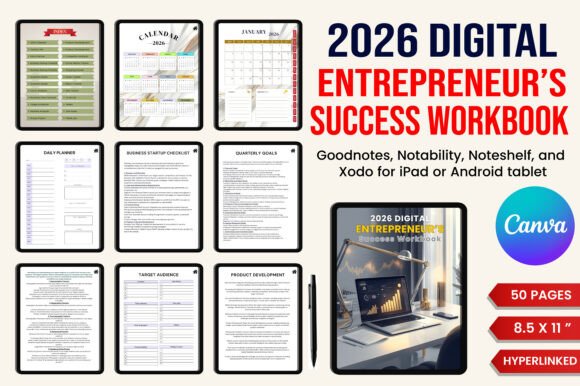
Most planners offer space to write tasks or dates. The 2026 Digital Entrepreneur’s Success Work goes deeper. Its 2026 yearly and monthly calendars are embedded with purpose: each month includes dedicated sections for quarterly goal review, SWOT analysis refreshes, and target audience reflection. This means you’re not just tracking time—you’re aligning daily actions with strategic intent. For example, a freelance web designer launching a new service package in Q2 can use the April–June quarterly goals spread to define milestones (e.g., “finalize pricing by April 15,” “publish landing page by May 10”), then cross-reference those against the daily planner to block focused work time—no more guessing what to prioritize on Tuesday afternoon.
Clarity Starts With Structure—Not Motivation
Motivation fades. Systems endure. The 2026 Digital Entrepreneur’s Success Work builds that system into its core layout. The Business Startup Checklist isn’t a generic list—it’s staged across phases: pre-launch validation (e.g., “Confirm minimum viable audience size via survey”), legal setup (e.g., “File DBA or LLC in home state”), and post-launch refinement (e.g., “Collect first 5 testimonials within 30 days”). Small business owners using this during a soft launch report spending 30–40% less time reworking foundational steps because the checklist surfaces dependencies early—like realizing shipping logistics must be resolved before finalizing product packaging.
Real-Time Tracking Without Tech Overload
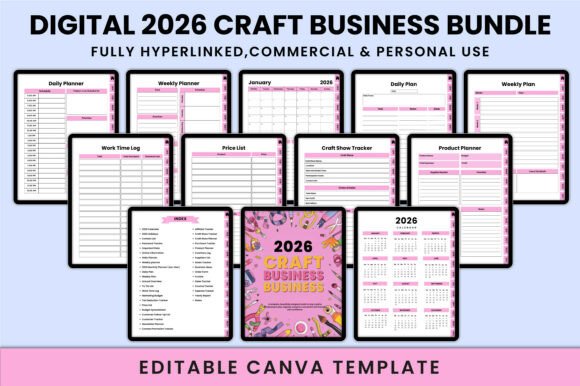
You don’t need five SaaS tools to manage ads, orders, returns, and social content. The 2026 Digital Entrepreneur’s Success Work consolidates these into simple, printable trackers—all sized for standard 8.5×11 printing. A solopreneur running an Etsy shop uses the Order Tracker to log purchase date, platform fee, shipping carrier, and delivery confirmation. When a customer emails about a delayed package, they flip to that page—not dig through email threads or spreadsheets. Similarly, the Ads Tracker helps compare spend vs. conversion across platforms without logging into Meta or Google Ads every day. It’s low-friction accountability: if it’s not written down here, it’s not part of the plan.
Designed for Iteration, Not Perfection
Digital entrepreneurship is iterative. Your target audience shifts. Competitors pivot. Product features evolve. The 2026 Digital Entrepreneur’s Success Work supports that reality with built-in flexibility: dual Product Development spreads let you document Version 1 assumptions *and* Version 2 learnings side-by-side; the Competitor Analysis section prompts comparison across three dimensions—pricing, messaging, and customer pain points addressed—not just surface-level feature lists. One educator launching an online course used the Markets Analysis page to map demand signals (e.g., rising Google Trends for “AI prompt engineering for teachers”) alongside her own capacity—helping her narrow from six course ideas to one with both traction and realistic development scope.
Who Benefits Most—and Why
This workbook serves best those who value intentionality over improvisation—but aren’t ready (or willing) to invest in complex project management software. Freelancers managing multiple clients appreciate the Daily Planner’s clean time-blocking format, which fits neatly beside a laptop without digital distraction. Bloggers and creators find the Social Media Tracker invaluable for maintaining consistency without burnout—scheduling Instagram carousels and newsletter segments across weeks, not just days. Startups with 1–3 team members use the Group Project pages to assign roles, set shared deadlines, and track blockers visually—no Slack thread required.
It’s less ideal for enterprises needing automated reporting or real-time collaboration. If your team relies on live document editing, version history, or API integrations, a digital tool may better suit your workflow. But for solo founders, micro-agencies, and bootstrapped teams, the tactile act of writing, checking off, and flipping pages reinforces ownership and focus in ways screens often dilute.
Editable Canva Access: Where Practicality Meets Customization
The included editable Canva link isn’t just a bonus—it extends the workbook’s usefulness. Need to brand your contact list with your logo? Adjust the color scheme of your Quarterly Goals page to match your brand palette? Resize a tracker for wall display in your home office? All possible. The 50 Canva templates cover variations of every core section—from minimalist dot-grid notes to bold headline-driven SWOT layouts—so you’re never stuck with a format that doesn’t fit your thinking style. One podcast host replaced the default Notes page with a custom “Guest Prep” template, adding fields for talking points, audio checklists, and follow-up action items—then duplicated it for every episode.
Small Details, Big Impact
Thoughtful design choices add up. The 8.5×11 page size ensures compatibility with standard binders, desk pads, and printers—no scaling or cropping needed. Dot notes provide subtle guidance for sketching flowcharts or mind maps without rigid lines restricting creativity. The Contact List includes columns for “Last outreach date” and “Next touchpoint”—turning networking from passive storage into active relationship management. Even the “Thank You Files” section encourages intentional gratitude practice, which users report strengthens client retention and referral flow when consistently maintained.
A Tool That Grows With You
Your business won’t look the same in January and December—and neither should your planning tool. The 2026 Digital Entrepreneur’s Success Work anticipates that evolution. Early-year pages emphasize discovery and validation; mid-year spreads shift toward optimization and delegation; Q4 focuses on reflection, metrics review, and 2027 intention-setting. It doesn’t assume you’ll have everything figured out upfront. Instead, it gives you room to learn, adapt, and build confidence—not through certainty, but through consistent, documented progress.
At its core, the 2026 Digital Entrepreneur’s Success Work answers a quiet but persistent question many entrepreneurs carry: “How do I stay grounded while moving fast?” It doesn’t promise overnight success. It offers something more reliable—a framework that turns scattered energy into focused momentum, one intentional page at a time.