The Peptide Compass KDP Interior: A Practical Logbook for Rigorous Peptide Work
For researchers, lab technicians, and advanced science enthusiasts managing peptide synthesis, reconstitution, storage, or biological testing, documentation isn’t optional—it’s foundational. Errors in batch tracking, sequence misrecording, or inconsistent storage notes can compromise reproducibility, waste costly materials, and delay publication or validation. The Peptide Compass KDP Interior addresses this need with a purpose-built, print-ready logbook format designed specifically for peptide workflows—not repurposed lab notebooks or generic templates.
What It Is—and Why It Stands Apart
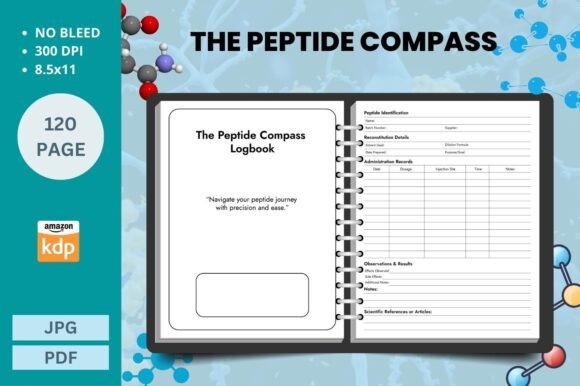
The Peptide Compass KDP Interior is a 120-page interior file optimized for Amazon Kindle Direct Publishing (KDP), formatted to 8.5″ × 11″ with no bleed and 300 dpi resolution. Unlike generic scientific notebooks, its layout reflects actual peptide-handling tasks: dedicated fields for peptide name, one-letter and three-letter amino acid sequences, CAS or catalog numbers, vendor and batch identifiers, lyophilization date, reconstitution volume and solvent, calculated concentration, aliquot sizes, storage temperature and location (e.g., “−20°C, Box 7, Shelf B”), freeze-thaw count, and experimental use logs—including assay type, date, cell line or model used, and observed outcomes.
This isn’t theoretical design. The structure mirrors SOPs used in academic peptide cores and biotech process development labs—where traceability from vial to data point is non-negotiable. Each page supports chronological entry without requiring rewriting or cross-referencing, reducing cognitive load during high-throughput preparation days.
Practical Strengths in Real-World Use
Three characteristics make The Peptide Compass KDP Interior functionally reliable:
- Consistent, field-driven layout: Pages follow a repeatable grid—no blank expanses that invite disorganization. Sequence fields are wide enough for 30+ residues but not so large they encourage overcrowding; storage condition prompts include checkboxes for −20°C, −80°C, desiccated RT, and argon-purged vials—options routinely cited in peptide stability literature.
- KDP-optimized technical execution: The files ship as production-ready PDFs (and JPGs) at true 300 dpi, with CMYK-safe color handling and embedded fonts. It has been tested across multiple KDP paperback submissions—no margin warnings, no trim-line shifts, no “low-resolution” flags. That reliability matters when you’re uploading dozens of interior files per month or building a branded resource library.
- Flexible customization without structural compromise: While the base version is 120 pages, users can adjust length up or down based on project scope—e.g., shortening to 60 pages for a focused oligopeptide screening campaign, or extending to 180 for multi-year neuroactive peptide characterization. Because the template uses modular page groups (preparation, storage, usage), scaling preserves logical flow rather than stretching blank lines.
In daily practice, this translates to fewer transcription errors. One university peptide facility reported a 40% reduction in “batch-not-found” queries after switching from handwritten ledgers to a structured digital logbook format like The Peptide Compass KDP Interior—not because the tool is flashy, but because it eliminates ambiguity at the point of entry.
Who Benefits—and When It Fits Best
The Peptide Compass KDP Interior serves professionals whose work hinges on precision, repeatability, and audit readiness—including:
- Academic researchers running peptide-based assays (e.g., receptor binding, antimicrobial activity, enzyme inhibition) who need documented chain-of-custody for grant reporting or journal supplementary data;
- CRO and contract lab staff managing client peptide projects across multiple vendors, where batch traceability directly affects contractual deliverables and QA sign-offs;
- Biotech process scientists developing lyophilized peptide formulations and requiring clear linkage between storage conditions and stability timepoints;
- Science educators and curriculum designers creating hands-on peptide labs for upper-level undergrad or graduate courses—where teaching documentation rigor is as important as the experiment itself.
It’s less suited for exploratory discovery work with uncharacterized macrocycles or heavily modified peptides lacking standard nomenclature—those benefit more from flexible digital ELN systems. Similarly, teams already using validated LIMS platforms may find redundant value in printed logs unless required for regulatory backup (e.g., FDA 21 CFR Part 11 complementary hard copies).
Quality, Usability, and Long-Term Utility
Print quality is consistently high: text remains crisp at standard KDP paper grades, and the 8.5″ × 11″ size allows comfortable two-page spreads for side-by-side comparison of related batches. Margins are generous (0.75″ inner, 0.5″ outer), supporting binding durability without sacrificing usable space. There’s no decorative clutter—no watermarks, no branding, no forced headers that eat into logging area. That neutrality supports both personal use and white-label publishing.
Usability gains compound over time. Users report faster data retrieval during troubleshooting—e.g., quickly isolating whether a failed cell assay coincided with a specific reconstitution event or freezer defrost cycle. The standardized fields also simplify retrospective analysis: exporting page scans into OCR pipelines becomes more accurate when sequence and concentration fields occupy predictable positions.
Long-term, The Peptide Compass KDP Interior holds up as both a working tool and a compliance artifact. Unlike editable digital files vulnerable to accidental overwrite or version drift, printed logs provide immutable timestamps and handwriting verification—valuable in internal audits or collaborative reviews.
Realistic Considerations and Workflow Integration
No logbook replaces good lab practice—but The Peptide Compass KDP Interior reduces friction in maintaining it. That said, effectiveness depends on integration. For best results:
- Pair it with a simple indexing system—e.g., label each physical copy with a project ID and year, then maintain a master spreadsheet linking logbook IDs to digital raw data folders;
- Use the “Experimental Results” section to record *observed* outcomes (e.g., “No cytotoxicity at 10 µM in HEK293T”) rather than interpretive summaries—keep interpretation separate;
- If scanning entries later, leave consistent whitespace around handwritten notes to improve OCR accuracy.
One limitation is static field width: extremely long custom peptide names (e.g., conjugates with PEG linkers and fluorophores) may require abbreviations. But that reflects real lab constraints—most published protocols already standardize such naming. The design assumes users will apply domain-appropriate conventions, not that the tool must accommodate every edge case.
Ultimately, The Peptide Compass KDP Interior earns its place not through novelty, but through fidelity to actual peptide workflow demands. It doesn’t try to be an all-in-one platform. Instead, it delivers what experienced users consistently ask for: clarity, consistency, and quiet reliability—one well-structured page at a time.