🧢 Baseball Planner: Organize, Train, and Play Like a Pro
If you’ve ever juggled practice schedules, forgotten gear before a game, lost track of batting averages across weeks, or struggled to translate coaching feedback into real skill growth—you’re not alone. The 🧢 Baseball Planner was built precisely for those moments: the quiet chaos behind every polished performance. It’s not just another notebook or generic calendar app. It’s a purpose-built system for players and coaches who want clarity, consistency, and measurable progress—without reinventing the wheel each season.
Why This Isn’t Just Another “Baseball Journal”
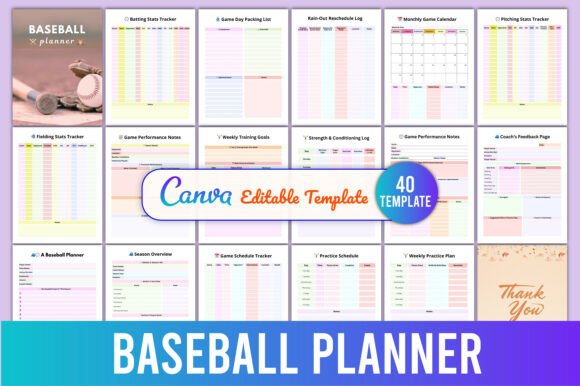
Many assume any lined notebook or free printable will do. But baseball demands structure that matches its rhythm: daily preparation, weekly refinement, seasonal reflection. A planner that treats pitching mechanics the same as lunchbox reminders misses the point. The 🧢 Baseball Planner bridges that gap with intentional design—like dedicated stat trackers that align with official scoring standards, or pre-game checklists that account for weather, field conditions, and equipment wear—not just “bat and glove.”
It’s also built for real-world use, not idealized routines. That means editable Canva templates (not static PDFs you can’t adjust), print-ready files that won’t blur at 150% zoom, and JPGs sized for tablet annotation—no guesswork when switching between screen and paper.
Mistake #1: Assuming “Printable” Means “Ready to Use”
Some download planners only to find fonts don’t embed, margins shift when printed, or pages bleed off the edge. Others open editable files only to discover they require premium Canva plans or unsupported design software. That wastes time and undermines trust in the tool before day one.
Better approach: Before downloading, verify the 🧢 Baseball Planner includes true print-ready PDFs (with embedded fonts and CMYK-safe colors) *and* a Canva link that works on the free tier. Check user reviews mentioning actual printing results—not just “cute design.” If the seller doesn’t specify paper size compatibility (e.g., US Letter vs. A4), ask. A planner that looks great online but jams your printer isn’t saving time—it’s creating friction.
Mistake #2: Using Stats Pages Without Context
Tracking hits is easy. Understanding *why* your line-drive rate dropped in week three? That requires more than raw numbers. Many users fill out batting logs religiously but skip the adjacent reflection prompts—like “What changed in my stance?” or “How did pitch selection differ?” Without that layer, stats become noise, not insight.
Better approach: Treat the 🧢 Baseball Planner’s stat trackers as paired tools—not solo features. When logging a game, spend two minutes on the “Performance Notes” section beside your numbers. Did you adjust your grip after Tuesday’s bullpen session? Did fatigue affect your first-pitch strike percentage? Link cause and effect. Coaches can even use these notes to spot patterns across players—like shared timing issues during late-afternoon games.
Mistake #3: Ignoring the Coach’s Feedback Pages
Feedback often lives in scattered texts, voice memos, or mental notes. When it’s not captured alongside goals and training logs, it rarely translates into action. One high school coach told us his team’s biggest gap wasn’t talent—it was continuity between what he observed and what players practiced next.
Better approach: Reserve the 🧢 Baseball Planner’s Coach’s Feedback Pages for *actionable* notes—not general praise (“great effort!”) but specific, observable cues (“Your front shoulder opened 0.3 seconds early on curveballs—try this drill”). Then cross-reference those notes with the Skill Development Training Logs. That turns feedback from commentary into curriculum.
Mistake #4: Skipping Pre-Game Prep—Even When You Think You’re “Good”
We’ve all been there: arriving at the field missing batting gloves, forgetting the backup catcher’s mask, or realizing too late the turf shoes need re-studding. Overconfidence in memory leads to avoidable stress—and sometimes, missed opportunities. One college pitcher missed warm-up time because his weighted ball set stayed in the garage.
Better approach: Use the 🧢 Baseball Planner’s pre-game checklists *consistently*, even for low-stakes scrimmages. Customize them per role (pitcher, infielder, coach) and condition (rain, night game, travel). Keep a laminated version in your bag. Better yet—assign one player each week to lead checklist review. It builds accountability and catches oversights before they matter.
What to Check Before You Commit
Before adding the 🧢 Baseball Planner to your routine—or recommending it to your team—ask yourself three things:
- Does it scale with your role? A youth coach needs different templates than a pro prospect. Verify the planner includes flexible sections—like blank lineup grids *and* position-specific drills—not just one-size-fits-all pages.
- Is digital usability matched by physical reliability? If you annotate on tablet, test the JPG resolution. If you print weekly, confirm the PDF has crop marks and bleed-safe layouts. Don’t assume “digital-friendly” means “tablet-optimized.”
- Does it support reflection—not just recording? Look past the checkboxes. Do weekly reviews prompt honest assessment (“What distracted me in practice?”) or just ask “Did I complete drills?” The difference separates habit-building from growth.
Realistic Expectations, Real Results
The 🧢 Baseball Planner won’t make you hit .400 overnight. But it *will* expose gaps you didn’t know existed—like how often you skip recovery days, or how rarely you review video alongside your fielding log. Its strength lies in consistency, not magic. One semi-pro outfielder used it to identify that her drop in caught fly balls correlated directly with skipping dynamic warm-ups on cloudy days. She adjusted—and cut errors by 37% in six weeks.
That kind of insight doesn’t come from more data. It comes from better-organized, better-connected data—and the space to interpret it. Whether you’re a first-year coach building your first season plan or a veteran player refining your third pro contract prep, the 🧢 Baseball Planner works because it respects your time, your goals, and the complexity of the game itself.
It’s not about doing more. It’s about doing what matters—with focus, intention, and zero guesswork.