Affiliate Marketing Guide Workbook
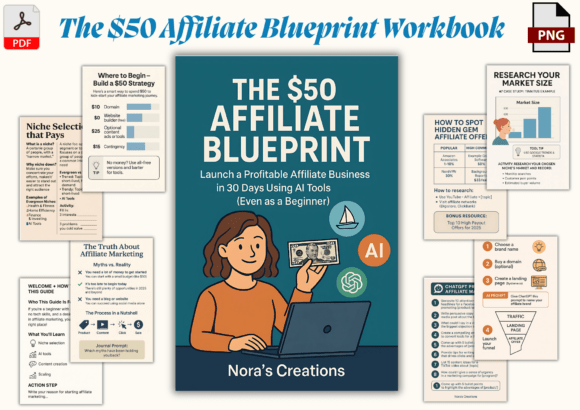
If you’ve ever wondered how to earn income by recommending products you genuinely like—without creating your own—this is where clarity begins. The Affiliate Marketing Guide Workbook isn’t another dense ebook or vague webinar replay. It’s a 21-page, printable, AI-integrated roadmap designed for real action—not theory.
What It Actually Is (and What It’s Not)
This workbook is a tactile, visual, and task-oriented companion. Measuring 6x9 inches and delivered as both PDF and PNG files, it’s built for flexibility: print it and write in the margins, load it into Notion or GoodNotes, or flip through it on a tablet during coffee breaks. Every page serves a purpose—no filler, no “about the author” bios, no upsells.
It integrates free AI tools not as gimmicks, but as practical levers: ChatGPT for drafting emails and social posts, Midjourney for generating niche-specific visuals, RunwayML for quick video snippets. These aren’t optional add-ons—they’re woven into worksheets, trackers, and funnel diagrams so beginners don’t need to hunt for prompts or guess at workflows.
For Beginners Who Feel Overwhelmed
If your idea of affiliate marketing still involves Googling “how to start” at 2 a.m., this workbook meets you where you are. It starts with myth-busting—like clarifying that you don’t need a massive audience or a website to begin—and moves straight into choosing a niche based on payout potential *and* personal alignment. One beginner used the included “Niche Offer Research” worksheet to compare three low-competition health sub-niches, then launched a simple Pinterest account focused on eco-friendly menstrual products—landing her first commission in 11 days.
For Creators Building Audience Trust
You already make content—whether it’s Reels, newsletters, or YouTube shorts—but monetizing feels transactional or inconsistent. The Affiliate Marketing Guide Workbook helps you align promotions with your existing voice. Its 30-day social media plan doesn’t ask you to go viral; instead, it scaffolds content around value-first hooks (“How I cut my grocery bill by 30% using this tool”) and subtle, trackable CTAs. A podcast host repurposed the “Funnel Tracking Sheets” to map listener drop-off points—and discovered her mid-episode callouts converted 3x better than end-of-show links.
For Educators & Freelancers Adding Income Streams
You understand learning design, curriculum, or client communication—but translating that into scalable income can be tricky. This workbook treats affiliate marketing as a skill you *teach yourself*, not a lottery ticket. The journal prompts and burnout tips aren’t generic self-care advice; they’re tied to real workflow rhythms—like scheduling AI-assisted content batches every Tuesday, or reviewing conversion data only once per week. One freelance copywriter used the “Scaling Guide” to shift from one-off commissions to recurring income: she now recommends two SaaS tools she uses daily, embedding them naturally into client onboarding emails—and earning passive income while sleeping.
For Small Business Owners Evaluating Partnerships
You’re not looking to become an affiliate—you’re evaluating whether to *work with* affiliates. The workbook’s funnel tracking sheets and visual funnels give you insight into what high-performing partners actually do behind the scenes. You’ll recognize patterns: which touchpoints drive clicks vs. sales, how top performers layer storytelling with data, where trust-building happens before the link appears. That understanding helps you design better partner onboarding, clearer commission structures, and more effective creative briefs.
Practical Priorities—Match It to Your Needs
Not every resource serves every goal. Here’s how the Affiliate Marketing Guide Workbook lines up with common decision factors:
- Ease of use: Designed for immediate application—worksheets are fill-in-the-blank, checklists are actionable, and AI prompts are pre-tested. No setup required.
- Cost: Priced at $50, it includes lifetime access to updates and the full ChatGPT prompt library—no subscriptions, no hidden fees.
- Flexibility: Works whether you're building on Instagram, email, TikTok, or even offline (e.g., handing printed funnels to local wellness coaches).
- Learning value: Each section explains *why* a step matters—not just how to do it. For example, the “Affiliate Marketing Basics” page contrasts CPA vs. revenue share models using real-world examples, helping readers choose partners aligned with their goals.
- Long-term usefulness: The trackers and journal prompts remain relevant whether you’re making $5 or $5,000/month. One user revisited the “Burnout Tips” section after six months—not because she was overwhelmed, but to refine her consistency rhythm as her workload grew.
When It Fits—and When It Might Not
This workbook shines if you prefer doing over reading, value structure without rigidity, and want to avoid paying for tools you don’t yet need. It’s ideal if you learn best by writing, sketching, or checking off boxes—not watching hour-long tutorials.
It may not be your first choice if you’re already running a six-figure affiliate site and need advanced analytics integrations or white-label reporting. Nor is it built for teams needing collaborative dashboards or role-based permissions. But for solo practitioners, side hustlers, educators adding digital literacy to their curriculum, or creators launching their first monetized project—it bridges the gap between intention and income with quiet confidence.
A Realistic Starting Point
There’s no promise of “get rich quick.” What the Affiliate Marketing Guide Workbook delivers is something quieter but more durable: a repeatable, adaptable, human-centered process. One teacher used the “Social Media Plan” to launch a micro-community for homeschooling parents—recommending only resources she’d tested with her own kids. Six months in, she earns enough to cover her classroom supply budget. A hobbyist photographer applied the “Tool Stack Guide” to create AI-generated behind-the-scenes reels for camera gear she loved—and now gets early access to new product launches from brands impressed by her authentic approach.
That’s the thread connecting every use case: relevance over reach, clarity over complexity, and progress measured in small, confident steps—not overnight transformations.