Autism Workbook for Women
If you’ve ever scrolled through therapy resources and felt like most tools were built for someone else—someone whose emotional cues line up neatly with neurotypical expectations, whose daily rhythms match a standard 9–5 template, or whose idea of “self-reflection” doesn’t involve sensory overwhelm or executive function fatigue—you’re not alone. The Autism Workbook for Women was created with that quiet, persistent gap in mind: a space where autistic adults—especially women, who are often misdiagnosed, overlooked, or expected to mask relentlessly—can slow down, name what’s true for them, and build structure without sacrificing authenticity.
What This Workbook Actually Does (in Real Life)
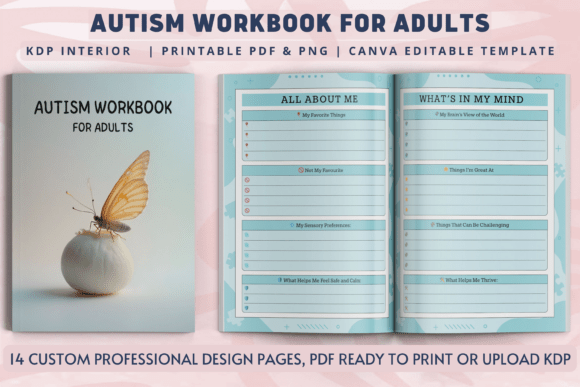
This isn’t a clinical assessment tool or a rigid curriculum. It’s a living document—one you can open on a rainy Tuesday morning when your brain feels scattered, or during a calm Sunday afternoon when you want to gently reconnect with yourself. Because it’s a Canva-editable template printable PDF, you’re not stuck with static pages. You can change fonts to reduce visual stress, swap out icons for ones that resonate, add your own photos to “My Favourite Places,” or even translate sections into another language if that supports your understanding better.
Think of it as scaffolding—not a script. For example:
- When social energy runs low: Use the My Social Story and Social Stories and Plans pages to rehearse a coffee date, a team meeting, or a family gathering—not by scripting “perfect” responses, but by naming your needs (“I might need to step outside for 3 minutes”), listing exit strategies, and noting who feels safe to signal to.
- When emotions feel too big or too vague: The All About Emotions spread includes visual scales, body-map prompts (“Where do I feel this in my chest? My shoulders? My jaw?”), and low-pressure word banks—not to label feelings correctly, but to widen your emotional vocabulary at your own pace.
- When routines collapse: The My Daily Routine page isn’t about filling in every hour. It invites flexibility—color-coding energy levels, adding sensory anchors (“sip mint tea at 3 p.m.”), or marking “buffer zones” between tasks so transitions don’t derail your whole day.
Who Uses It—and Why It Fits So Many Roles
The Autism Workbook for Women works across roles because it meets people where they are—not where systems assume they should be.
Therapists and coaches use it as a collaborative tool—not something to assign, but to co-create. One occupational therapist shared how she prints just three pages per session: What’s in My Mind (Version A for linear thinkers, Version B for associative or image-based processors), My Comfort Tools, and My Support Plan. Clients fill them in between sessions—or together—and bring insights back that shape real-world goals, like negotiating remote work accommodations or identifying early burnout signals.
Caregivers and partners find it helpful not as a “fix-it” guide, but as a bridge. One woman described using the All About Me and Strengths Superpowers pages with her nonverbal adult daughter—drawing, pasting magazine cutouts, and recording voice notes. What emerged wasn’t just preferences, but patterns: “She lights up near water, shuts down under fluorescent lights, and solves puzzles faster than anyone I know. That’s not ‘symptom management’—that’s honoring who she is.”
Educators and support coordinators adapt pages for IEP meetings or transition planning. The My Communication Style page becomes a concrete handout for teachers: “I process best with written instructions + 10 seconds to respond. I may look away when listening—that helps me focus.” No jargon. Just clarity.
Digital creators and small biz owners use the editable Canva file to build niche offerings—adding their branding, bundling with video walkthroughs, or creating companion audio guides. Since it’s KDP-ready (8.5×11 with bleed, 121 pages), many turn it into a low-cost, high-impact digital product—especially valuable for audiences who distrust generic “self-care” content but crave practical, neurodivergent-affirming tools.
Things to Keep in Mind Before You Begin
Like any tool, the Autism Workbook for Women shines brightest when used with intention—not obligation.
It’s designed to support self-awareness, not diagnose. If you’re newly exploring autism or seeking formal evaluation, this workbook complements—but doesn’t replace—clinical guidance. Some users report feeling emotional while completing pages like What’s in My Mind or All About Me, especially after years of masking. That’s normal. There’s no deadline, no “right way” to fill it out. Skip pages. Revisit them months later. Tear one out and tape it to your mirror.
Also: while the title says “for Women,” its core design honors gender diversity. Many nonbinary, trans, and gender-expansive adults find deep resonance here—not because it assumes a binary identity, but because it centers experiences common among those assigned female at birth (like camouflaging, late diagnosis, or being labeled “shy” or “overly sensitive”). The language stays inclusive, and the editable format means you can rename sections to fit your truth.
One limitation worth noting: because it’s print-and-go (and Canva-editable), it doesn’t include interactive features like auto-saving or speech-to-text. That’s intentional—it prioritizes accessibility for those who avoid screens, struggle with digital overload, or prefer tactile engagement. But if screen-based journaling is essential for you, consider printing select pages to use alongside your preferred app.
Small Moments, Big Shifts
You won’t find dramatic promises in this workbook—no “cure burnout in 7 days” or “master emotional regulation by Friday.” What you will find is permission: to describe your sensory world honestly, to list “watching birds” as a valid coping strategy, to name “asking for help” as a strength—not a failure.
A college student used the My Comfort Tools page to realize she always carried noise-canceling earbuds *and* a fidget ring—but never both at once. After pairing them intentionally before lectures, her focus improved noticeably. Another user filled out My Support Plan with her partner, turning vague hopes (“I wish you’d understand when I shut down”) into concrete actions (“If I say ‘I need quiet,’ please close the door and text me a heart emoji in 20 minutes”).
These aren’t grand transformations. They’re grounded, repeatable adjustments—made possible because the Autism Workbook for Women meets neurodivergent thinking on its own terms: visually rich but not overwhelming, structured but not prescriptive, respectful of depth over speed.
Whether you’re holding it in your hands after a long day, editing a cover page in Canva at midnight, or handing a printed copy to someone who’s spent years feeling unseen—the power isn’t in the pages themselves. It’s in the quiet certainty they offer: Your experience matters. Your rhythm is valid. And you get to define what support looks like—for you.