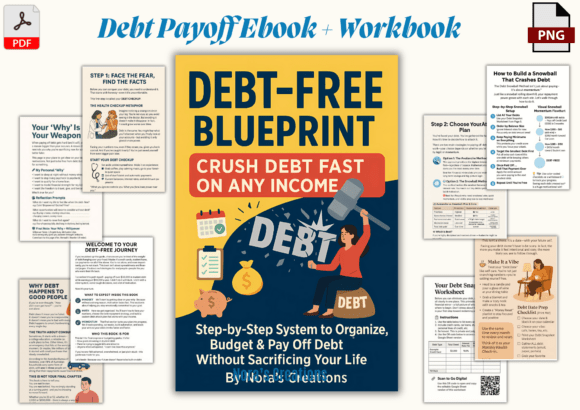
Debt Payoff Ebook Workbook
You don’t need more income to get out of debt—you need clarity, consistency, and a system that works with your real life. The Debt Payoff Ebook Workbook isn’t another abstract finance theory or rigid spreadsheet. It’s a 21-page, printable, action-oriented guide built for people who want progress—not perfection. Designed at 6 x 9 inches (A4 compatible), it fits on your desk, in your planner, or beside your morning coffee. Every page serves a purpose: to simplify, focus, and move you forward—no financial degree required.
A System Built for Real People, Not Perfect Budgeters
What sets this workbook apart is its intentional structure: Mindset, Math, and Momentum. Too many debt tools jump straight to numbers—but if your confidence, habits, or emotional relationship with money hasn’t shifted, spreadsheets won’t hold. This workbook begins with reflection prompts and affirmation pages—not as filler, but as functional groundwork. You’ll name what debt *feels* like, identify spending triggers, and reconnect with your “why” before calculating a single payment.
The Math section follows with grounded, visual tools: a clean debt snapshot worksheet where you list balances, interest rates, and minimums—all in one glance. No hidden formulas, no confusing categories. Then comes the payoff planning: both snowball *and* avalanche methods laid out side-by-side, with space to compare outcomes based on *your* numbers. You choose—not because one method is universally “better,” but because you see how each aligns with your motivation style and cash flow rhythm.
Momentum is where the workbook becomes truly adaptable. A 6-month check-in chart helps you track small wins—like skipping takeout twice or negotiating a bill—while habit checklists reinforce consistency without guilt. There’s even a personal debt-free declaration page, designed to be printed, signed, and displayed—not as a promise to the world, but as a quiet anchor for your own commitment.
Creative Uses Beyond Personal Finance
While created for individual use, the Debt Payoff Ebook Workbook opens creative doors for educators, coaches, and content creators. A financial literacy teacher can print select pages—like the debt snapshot or budgeting template—as handouts, then annotate them live during class. A freelance coach might embed the affirmation prompts into a client onboarding sequence, pairing them with weekly accountability calls.
Bloggers and newsletter writers use the workbook’s framework to develop companion content: a “Mindset Reset Challenge” series, a “Math Check-In” email with editable templates, or a “Momentum Tracker” Instagram carousel. Because the PDF includes individual PNG files for each illustrated page, designers can remix visuals—adding brand colors, custom headers, or translated text—for workshops, digital courses, or nonprofit financial coaching programs.
Small business owners adapting the workbook for team wellness initiatives often extract the habit checklist and savings tracker, rebranding them as “Financial Resilience Tools” for employee benefit packages. Freelancers building passive income streams resell printed bundles—pairing the workbook with a 30-minute strategy session or a curated list of free negotiation scripts and credit-building resources.
Practical Adaptations for Different Contexts
If you’re working with limited bandwidth—say, a parent juggling shifts or a student balancing loans and part-time work—the workbook’s modularity helps. You don’t have to complete all 21 pages in order. Start with just the debt snapshot and one month of the budgeting template. Use the vertical PNGs as phone wallpapers for daily grounding. Print only the pages you’ll use that week—keeping clutter low and intention high.
For creators designing physical products, the 6 x 9 inch layout is ideal for printing as a slim, spiral-bound companion. Pair it with a set of colored pens and a simple folder—no fancy supplies needed. Educators adapting it for teens or young adults often simplify language on the affirmation prompts (“I am learning to make choices that support my future”) and add space for drawing or collage next to the “debt-free declaration.”
On digital platforms, the workbook shines when used interactively: upload the PDF to Notion or GoodNotes, then layer in your own notes, screenshots of bank balances, or voice memos summarizing weekly insights. The clean layout ensures readability across devices—and the lack of complex formatting means it converts smoothly to accessible formats like tagged PDFs or screen-reader-friendly HTML exports.
Keeping It Effective, Organized, and Human-Centered
Clarity starts with restraint. That’s why the Debt Payoff Ebook Workbook avoids overwhelming detail. No 50-line expense categories. No multi-tab calculators requiring macros. Instead: one column for income, one for fixed expenses, one for flexible—and clear instructions beside each. Consistency comes from repetition with variation: the same tracker format appears in different contexts (budgeting, savings, payoff progress), so users build fluency without memorizing new layouts.
Originality lives in how you personalize it. Underline phrases that resonate. Cross out categories that don’t apply. Tape a sticky note with a win from last month onto the 6-month check-in chart. Let the workbook evolve with you—not as a static artifact, but as a living document of your financial growth.
Audience-friendliness means honoring where people actually are. That’s why motivational pages aren’t generic affirmations (“Money flows to me easily”). They’re specific, grounded, and actionable: “Today I chose one small step toward breathing easier about money.” That kind of language builds trust—and invites return visits, not one-time use.
Real Results, Not Just Theory
One side-hustling graphic designer used the debt snapshot and snowball plan to pay off $8,200 in credit card debt in 11 months—while also launching her first digital product. She printed the budgeting template weekly, tracked every freelance invoice and coffee run, and celebrated each debt crossed off with a handwritten note on the corresponding page.
A community college counselor adapted the mindset prompts for a first-gen student cohort, leading group reflections before diving into loan repayment options. Students reported feeling “seen, not scolded”—a shift that led to higher follow-through on financial aid counseling appointments.
None of these outcomes came from the workbook alone. They came from pairing its structure with real-world action—and trusting that small, repeated choices compound faster than we expect.
The Debt Payoff Ebook Workbook doesn’t promise overnight freedom. It offers something more reliable: a clear path, usable tools, and permission to move at your own pace—without losing sight of where you’re going.